UK Gambling Commission and Crypto Betting: Where Regulation Stands in 2026
 Available in US
Table of Contents
- The UKGC’s Current Position on Cryptocurrency Payments
- Industry Forum: Exploring the Art of the Possible
- FCA Cryptoasset Regulations and the October 2027 Deadline
- Andrew Rhodes: “A Government-Level Decision”
- Consumer Protection Gaps Under the Current Framework
- What a Regulated Crypto Betting Framework Could Look Like
- Frequently Asked Questions
I spent a morning in February 2026 reading Tim Miller’s speech to the Betting and Gaming Council AGM, and one line stopped me cold. The UK Gambling Commission’s Executive Director told the room that “crypto” is one of the two biggest search terms directing British consumers to unlicensed gambling sites. Not a fringe concern buried in an appendix — the top regulator in UK gambling, speaking to the industry’s biggest annual gathering, flagging cryptocurrency as a primary driver of the black market.
That single admission reshaped how I think about crypto betting regulation in the UK. For years, the UKGC’s position on cryptocurrency payments has been a polite “no” — not explicitly banned, but effectively blocked by the requirement that all licensed operators use fiat-denominated payment methods traceable through conventional banking channels. No UKGC-licensed bookmaker accepts Bitcoin, Ethereum, or any stablecoin for deposits or withdrawals. The practical result: every crypto sportsbook available to UK punters operates offshore, beyond the Commission’s reach.
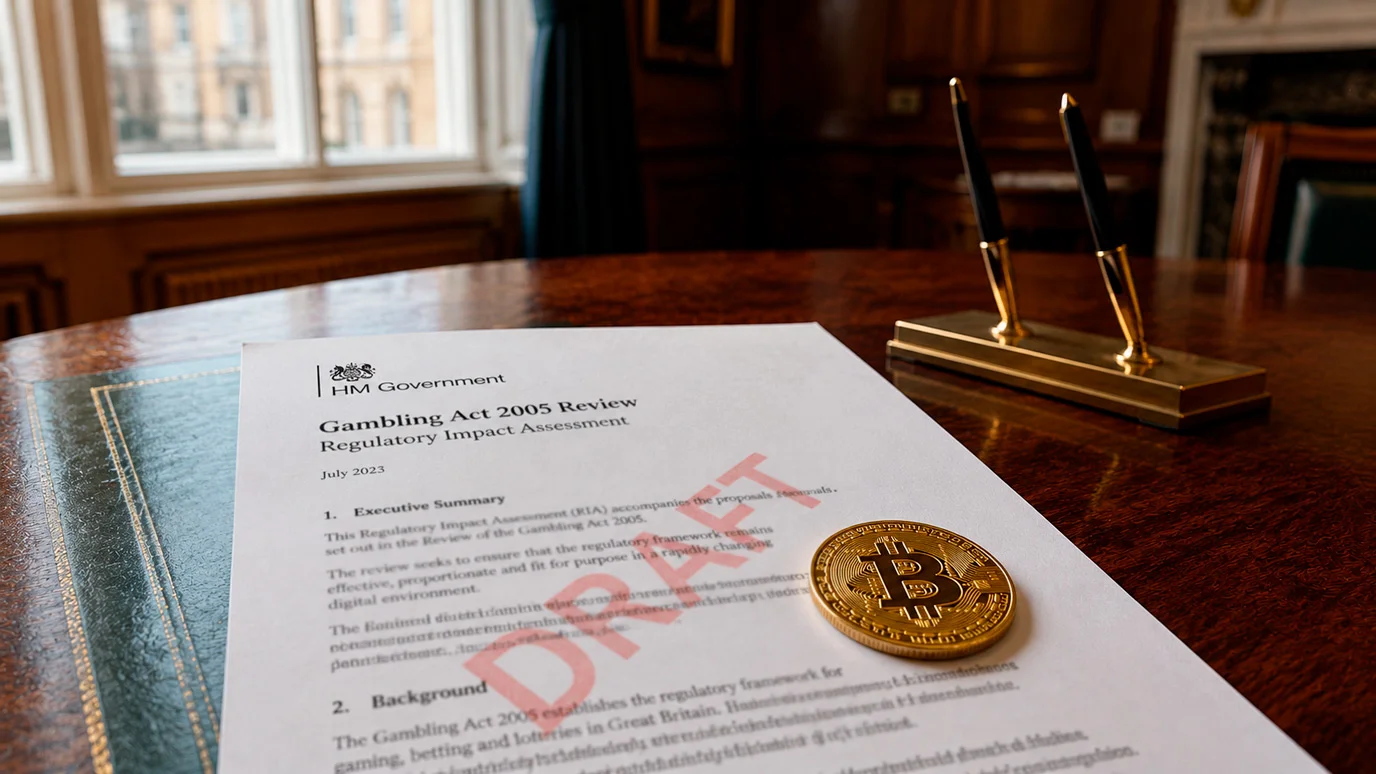
But 2025 and early 2026 brought signals that the regulatory ice is cracking. The Commission launched an Industry Forum to explore crypto payment integration. The FCA published its new cryptoasset regulatory framework with an October 2027 implementation deadline. And senior figures at the UKGC started using language I have never heard from them before — words like “innovation” and “art of the possible” in the same sentences as “cryptocurrency” and “gambling.” This article breaks down exactly where regulation stands, what the timeline looks like, and what it all means if you are a UK punter placing NFL wagers with crypto.
The UKGC’s Current Position on Cryptocurrency Payments
A compliance officer at a mid-tier UK bookmaker once told me, off the record, that the internal guidance on crypto was three words: “Don’t touch it.” That was 2021. Five years later, the official stance has evolved in tone but barely moved in practice.
The Gambling Act 2005 does not mention cryptocurrency — it predates Bitcoin by four years. What it does require is that licensed operators conduct thorough source-of-funds checks, anti-money-laundering due diligence, and financial risk assessments on every customer. These requirements were designed around bank transfers, debit cards, and e-wallets connected to regulated financial institutions. Cryptocurrency, by its architecture, sits outside that infrastructure. A Bitcoin deposit arrives from a wallet address, not a bank account. Tracing its origin requires blockchain analytics tools that most operators neither own nor understand.
The UKGC has never issued a formal prohibition on crypto payments. Instead, it has maintained what Tim Miller himself described as a de facto position: operators seeking or holding a UKGC licence understand that accepting cryptocurrency deposits would create compliance risks severe enough to jeopardise their licence. The result is identical to a ban without the legal formality of one.
This matters for NFL bettors because every crypto sportsbook advertising to UK users — and there are dozens — does so without UKGC oversight. They typically hold licences from Curaçao, Anjouan, or sometimes the Malta Gaming Authority, jurisdictions with varying degrees of consumer protection that I will examine later. The gap between where UK punters want to bet and where UK regulation allows them to bet is widening, and the Commission knows it. In his February 2026 speech, Miller acknowledged this tension directly, noting that the days of large weekly penalties for compliance failures seem to be easing, which opens space for more constructive conversations about enhancing the regulated offering.
The subtext is clear. The UKGC recognises that its current framework is pushing crypto-savvy bettors offshore rather than protecting them. The new cryptoasset regulatory regime being built by the FCA — expected by 25 October 2027 — gives the Commission a potential foundation to revisit this position. But until that framework is live, the status quo holds: no UKGC-licensed operator accepts crypto, and every crypto sportsbook serving UK users operates in a regulatory grey zone.
Industry Forum: Exploring the Art of the Possible
When a regulator starts quoting the language of innovation rather than compliance, pay attention. Tim Miller told the BGC AGM that he wants the Commission to approach crypto payments “in the spirit of exploring the art of the possible rather than starting from a position of finding all the reasons not to innovate.” I have been tracking UK gambling regulation for the better part of a decade, and that sentence is a genuine departure from the institutional caution that has defined the UKGC’s approach to new payment technologies.
The vehicle for this exploration is the Industry Forum — a structured consultation process the UKGC launched in late 2025 to bring together operators, payment providers, blockchain analytics firms, and compliance specialists. The Forum is not a legislative body and cannot change the law. What it can do is produce recommendations that shape how the Commission interprets its existing powers and what guidance it issues to licensees.
From what has been made public, the Forum is examining several core questions. First, whether blockchain analytics tools have matured enough to satisfy anti-money-laundering requirements — specifically, whether tracing the origin of a crypto deposit can meet the same evidentiary standard as tracing a bank transfer. Second, how stablecoin transactions might simplify compliance compared to volatile assets like Bitcoin, since a USDT deposit does not carry the same source-of-funds ambiguity as a BTC deposit that may have appreciated 40% since acquisition. Third, how to integrate crypto payment rails with existing responsible gambling tools like deposit limits, cooling-off periods, and affordability checks.
Miller also framed the Forum’s work against a stark backdrop: demand for crypto betting exists and will probably grow, and innovation should be one of the Commission’s central consumer protection tools when it comes to the illegal market. That last phrase is the key. The UKGC is not exploring crypto because it wants to — it is exploring crypto because the alternative is watching more UK punters migrate to unlicensed offshore platforms where no consumer protection exists at all.
I have spoken with operators who participated in early Forum sessions, and the consensus is that the Commission is genuinely listening rather than running a box-ticking exercise. Several participants noted that the UKGC’s technical understanding of blockchain analytics has improved markedly since 2023, when the same questions were met with scepticism. The Forum’s findings have not been published in full, but the direction of travel is unmistakable. The question is no longer whether the UKGC will engage with crypto payments, but how quickly the FCA’s parallel regulatory work gives them the legal infrastructure to do so.
FCA Cryptoasset Regulations and the October 2027 Deadline
The piece of legislation that will ultimately determine whether UKGC-licensed bookmakers can accept crypto has nothing to do with gambling law. The Financial Services and Markets Act 2000 (Cryptoassets) Regulations 2025 brings cryptoassets inside the FCA’s regulatory perimeter for the first time, and the full regime is expected to be operational by 25 October 2027.
I have read enough draft statutory instruments to last a lifetime, but this one genuinely matters for our niche. Until crypto is regulated as a financial instrument in the UK, the UKGC has no basis for accepting it as a legitimate payment method within licensed gambling. You cannot build compliance frameworks around an asset class that your own government has not defined. The 2025 Regulations fix that problem — not overnight, but on a clear timetable.
The framework covers several areas relevant to gambling payments. Crypto exchanges and custodial wallet providers operating in the UK will need full FCA authorisation, not just the anti-money-laundering registration that currently applies. Stablecoin issuers will face specific requirements around reserves and redemption rights. And the promotion of cryptoassets to UK consumers will be subject to the same financial promotion rules that govern other investment products. For the gambling sector, the most consequential element is the establishment of clear regulatory standards for crypto payment processors. Once an FCA-authorised entity can receive, hold, and transmit crypto on behalf of customers with the same compliance infrastructure as a bank or e-wallet provider, the UKGC’s primary objection to crypto payments — the inability to trace funds through regulated channels — largely dissolves.
The FCA’s own consumer research adds context. A quarter of UK crypto users said they would be more likely to invest in digital assets if regulation were stronger. That is a signal the FCA takes seriously, and it aligns with the UKGC’s own concern about consumer displacement to unregulated platforms. If stronger regulation increases trust, and trust brings activity back onshore, both regulators benefit.
The timeline is tight but plausible. The FCA has been consulting on crypto regulation since 2023, and the 2025 Regulations give it statutory authority to proceed. Industry participants I have spoken with expect the first authorisations for crypto payment service providers to land in mid-2027, with gambling-specific guidance from the UKGC following within six to twelve months — meaning the earliest realistic window for a UKGC-licensed bookmaker to accept crypto deposits is late 2027 or early 2028.
Andrew Rhodes: “A Government-Level Decision”
If Tim Miller represents the UKGC’s exploratory wing, Andrew Rhodes — the Commission’s CEO — is the institutional brake pedal. His November 2025 briefing laid out the political and practical obstacles with a bluntness that Miller’s more diplomatic language tends to avoid.
Rhodes told the industry that opening the door to crypto in gambling “is going to have to be government-level discussion, and it is a government-level decision because once you open that door, you cannot close it.” That framing is deliberate. Rhodes is signalling that the UKGC alone cannot authorise crypto payments in gambling. The decision sits with ministers, likely the Department for Culture, Media and Sport in coordination with the Treasury, because it implicates questions that go far beyond gambling regulation.
The questions Rhodes raised are worth unpacking. He asked whether government is prepared to treat crypto as a legitimate source of wealth for affordability checks — the assessments that UK-licensed operators must conduct to verify that customers can afford their gambling activity. Under current rules, a customer depositing from a Barclays account has a traceable income history. A customer depositing from a Bitcoin wallet does not, at least not through the same channels. Rhodes also raised source-of-funds concerns: if a punter deposits 0.5 BTC, can an operator verify that those coins were earned legitimately rather than obtained through fraud, ransomware, or other criminal activity?
These are not hypothetical problems. The growth in cryptocurrency ownership among younger demographics — 15% of UK adults aged 18 to 34 hold crypto, according to the FCA’s 2025 consumer research — means demand is concentrated precisely in the age group most likely to gamble online. Rhodes acknowledged this pressure directly, noting that cryptocurrency adoption among younger people is building within the system. But he distinguished between recognising pressure and yielding to it. His position, as I read it, is that the UKGC will not move on crypto until the government provides explicit political cover and the FCA provides the regulatory infrastructure.
Rhodes also made it clear that compliance enforcement is not softening while these conversations continue. He warned the industry directly: “There will be no warnings. We have undertaken nine suspensions in the last few weeks, and these are all on issues that we have repeatedly warned about.” That is not the language of a regulator about to relax standards. It is a signal that any future crypto integration will come with intense scrutiny, not a lighter touch.
The practical implication for UK NFL bettors is a longer wait than Miller’s more optimistic language might suggest. Even after the FCA’s regime goes live in 2027, the government-level decision Rhodes described could add another twelve to eighteen months of consultation, impact assessment, and ministerial sign-off. The regulatory timeline is real, but it is not fast.
Consumer Protection Gaps Under the Current Framework
Here is the paradox that keeps me up at night: the UKGC’s refusal to engage with crypto was designed to protect consumers, but it has created the largest consumer protection gap in UK gambling history.
The numbers tell the story. An estimated 1.5 million people in the UK place roughly 10 billion pounds annually on unlicensed gambling sites, and the black market’s share of total gambling turnover has grown from 0.5% to between 10 and 12% in just five years. Crypto is the primary payment rail for these offshore platforms — it is how punters deposit without triggering the banking restrictions that UK-licensed operators must respect. The government has responded with a 26-million-pound Illegal Gambling Taskforce, announced by Gambling Minister Baroness Fiona Twycross in early 2026, but enforcement against offshore operators is inherently limited. You cannot revoke a licence that was never issued by your jurisdiction.
For UK punters betting on the NFL with crypto, the protection gaps are concrete and personal. GamStop, the self-exclusion scheme that covers all UKGC-licensed operators, does not apply to offshore crypto sportsbooks. If you have registered with GamStop because of problem gambling concerns, every crypto bookmaker sits outside that safety net. I cover this in detail in my piece on GamStop and crypto betting sites, but the core issue is structural: self-exclusion only works when the operators you are excluding yourself from recognise the scheme.
Financial recourse is equally limited. A dispute with a UKGC-licensed bookmaker can be escalated to an Alternative Dispute Resolution provider approved by the Commission. A dispute with a Curaçao-licensed crypto sportsbook goes… nowhere meaningful. Curaçao’s regulatory framework does not provide individual complaint mechanisms for UK consumers. Your deposit, your bet, your problem.
Chris Elliot, a partner at London law firm Wiggin who specialises in gambling regulation, has argued that a credible, regulated pathway would be a more effective consumer protection tool than de facto prohibition — if it reduces the displacement of bettors offshore. That logic is hard to argue with. The current framework protects UK punters from licensed crypto sportsbooks that do not exist, while doing nothing about the unlicensed ones they actually use.
What a Regulated Crypto Betting Framework Could Look Like
I have spent enough time in regulatory consultation rooms to know that the gap between “exploring the art of the possible” and “here is your licence condition” is measured in years, not months. But the outlines of a regulated crypto betting framework are already visible if you read between the lines of what the UKGC and FCA have published.
The most likely model is not a blanket approval of all cryptocurrencies. It is a tiered approach. Stablecoins pegged to fiat currencies — USDT, USDC, and whatever UK-regulated stablecoins emerge under the FCA’s new framework — would almost certainly be permitted first. They solve the volatility problem that makes source-of-funds assessments so difficult with Bitcoin or Ethereum. If a punter deposits 500 USDT, the operator can treat it as roughly equivalent to a 400-pound deposit for affordability purposes. The value does not swing 15% overnight.
Volatile assets like BTC and ETH would likely face additional requirements. Operators might need to convert them to fiat or a regulated stablecoin at the point of deposit, eliminating the volatility risk during the betting lifecycle. Alternatively, they might be required to use FCA-authorised crypto payment processors that conduct their own source-of-funds analysis before transmitting funds to the gambling operator — effectively adding an intermediary layer that mirrors the role banks currently play.
Chris Elliot of Wiggin has made the counterintuitive argument that crypto can support a more robust control environment than fiat payments in some respects, particularly where cash is involved. A blockchain transaction is immutably recorded, timestamped, and traceable in ways that a cash deposit at a betting shop never will be. The challenge is not the technology — it is building the regulatory confidence to trust the technology.
An unnamed industry representative, quoted in trade press in February 2026, summarised the sector’s position: a regulated UK route would be a positive step, giving consumers more choice without weakening standards on safety and financial controls. That framing — choice within standards — is the political sweet spot that any workable framework will need to occupy.
My best estimate, based on every signal I have tracked, is that the first UKGC-licensed operator could accept stablecoin deposits by late 2028. Bitcoin and Ethereum acceptance, if it happens at all, would follow later and with heavier conditions. The NFL betting angle is particularly relevant here because the sport’s UK season runs from September to February — meaning the 2028/29 NFL season could be the first where UK punters have a regulated crypto option. That is a long way off, but it is also the first time a realistic timeline has existed.
Frequently Asked Questions
Has the UK Gambling Commission approved any crypto sportsbooks?
No. As of mid-2026, no UKGC-licensed operator accepts cryptocurrency deposits or withdrawals. The Commission has not formally prohibited crypto payments, but its compliance requirements effectively prevent licensed bookmakers from integrating them. Every crypto sportsbook currently accessible to UK punters operates under an offshore licence from jurisdictions like Curaçao or Malta.
When will the FCA’s cryptoasset regulatory regime take effect?
The Financial Services and Markets Act 2000 (Cryptoassets) Regulations 2025 sets a target of 25 October 2027 for the FCA’s full regulatory framework to become operational. This includes authorisation requirements for crypto exchanges, custodial wallet providers, and payment processors — the infrastructure the UKGC would need before considering crypto payment integration for licensed gambling operators.
Could UK-licensed bookmakers legally accept Bitcoin deposits in the future?
It is possible but not imminent. The UKGC’s Industry Forum is exploring how crypto payments could be integrated within existing licensing conditions, and the FCA’s 2027 regulatory framework would provide the necessary financial infrastructure. Stablecoins are more likely to be approved first due to their price stability, with volatile assets like Bitcoin potentially facing additional conversion or intermediary requirements. A realistic earliest window is late 2028.
How does the UKGC’s Industry Forum approach crypto betting innovation?
The Industry Forum is a structured consultation process launched in late 2025 that brings together operators, payment providers, blockchain analytics firms, and compliance specialists. It examines whether current anti-money-laundering tools can accommodate crypto transactions, how stablecoins differ from volatile assets for compliance purposes, and how responsible gambling tools like deposit limits and affordability checks could integrate with crypto payment rails. Its findings inform UKGC guidance but do not have legislative force.
Discover everything about crypto nfl betting here.
Check out our guide on USDT NFL Betting: Why Tether Dominates Crypto Sportsbook Transactions as well.
Created by the ”Crypto nfl Betting” editorial team.