Crypto NFL Parlay Betting: Multi-Leg Wagers at Crypto Sportsbooks
 Available in US
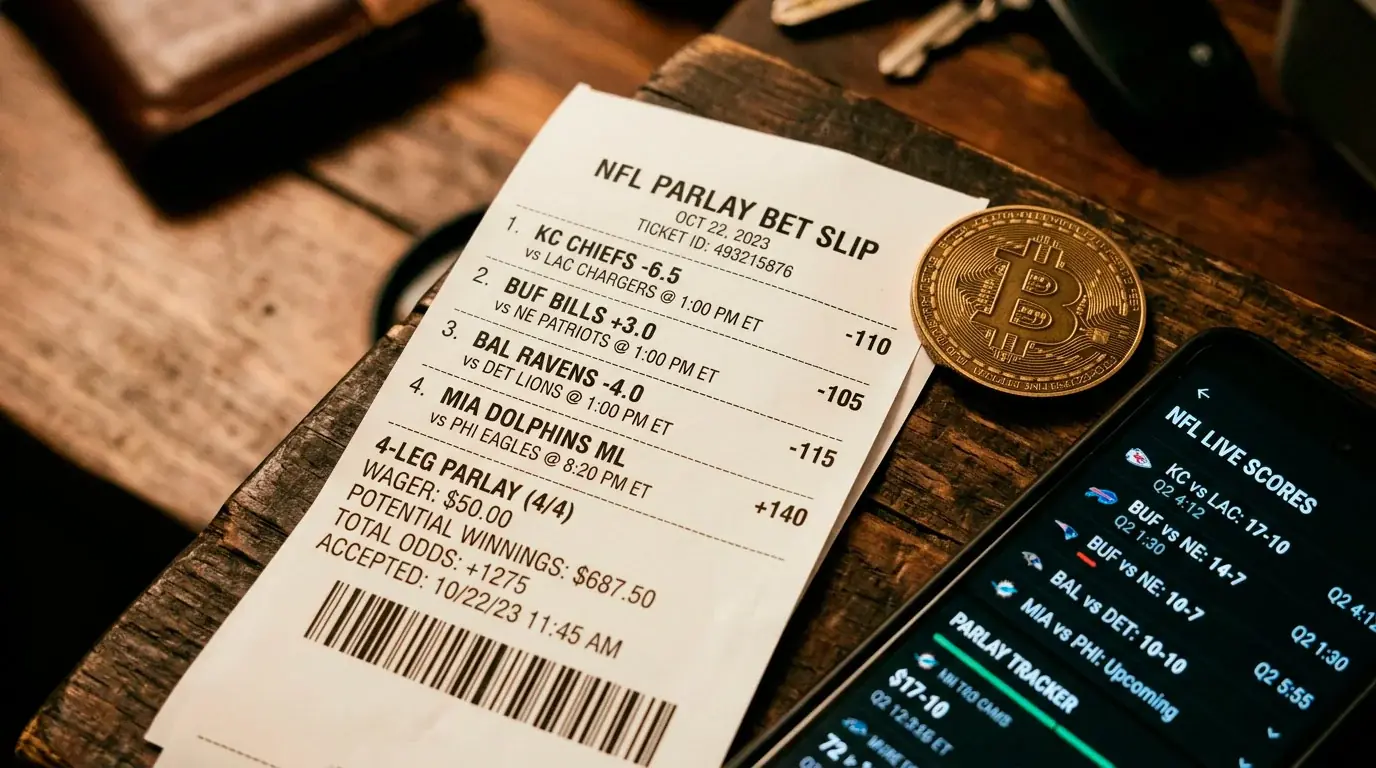
My worst Sunday of the 2024 NFL season involved a six-leg parlay where five legs hit and the sixth — a Travis Kelce anytime touchdown that seemed as close to a certainty as football allows — fell apart when Kelce left the game with a minor knee strain in the second quarter. One leg. One injury. An 18/1 payout vaporised. That experience crystallised everything I had learned about parlays at crypto sportsbooks: they are the most exhilarating and the most ruthlessly efficient bankroll destroyers in sports betting, and the crypto environment adds specific dynamics worth understanding before you stack legs.
How Crypto Sportsbooks Structure NFL Parlays
A parlay — known as an accumulator in UK betting circles — combines multiple selections into a single wager where every leg must win for the bet to pay out. The appeal is obvious: compound odds. Two -110 legs produce a roughly 2.6/1 payout; six legs push past 40/1. Crypto sportsbooks structure NFL parlays identically to fiat-based operators in terms of mechanics, but the edges of the experience differ in ways that matter.
Most crypto sportsbooks allow between 2 and 15 legs per parlay, with some platforms pushing to 20 or more. The payout calculations multiply the decimal odds of each selection, and the maximum payout cap varies wildly between operators. I have seen caps ranging from $50,000 to $500,000 at different crypto platforms, which becomes relevant if you are combining long-shot legs on a meaningful stake. Checking the maximum payout before building a high-odds parlay saves the unpleasant discovery that your theoretical 200/1 winner would have been capped at a fraction of the calculated return.
Same-game parlays — combining multiple selections from a single NFL fixture — have exploded in popularity across the betting industry. The American football betting market has grown from $8.52 billion to $9.5 billion over 2025-2026, and SGPs account for a disproportionate share of that growth. Crypto sportsbooks have followed the trend, with most major platforms offering same-game NFL parlays that let you combine a team moneyline, total points, and player props into a single ticket.
The correlation trap in same-game parlays deserves attention. If you back a team to win and their quarterback to throw for over 300 yards, those outcomes are positively correlated — teams that win often do so partly because their quarterback performs well. Sportsbooks adjust SGP pricing to account for this correlation, reducing the combined odds below what you would get multiplying independent probabilities. The adjustment varies between platforms, and crypto sportsbooks are not always transparent about their correlation models. Comparing SGP pricing across two or three platforms before placing reveals which operators apply the heaviest correlation penalties.
Parlay Odds, Expected Value, and the House Edge
Here is the uncomfortable mathematical truth about parlays that no sportsbook — crypto or otherwise — will volunteer. The house edge compounds with every leg you add. A single NFL spread bet at standard -110 lines carries a theoretical hold of about 4.5%. A two-leg parlay does not double that edge; it compounds it. By the time you reach six legs, the effective house margin exceeds 25%. The sportsbook’s expected profit on your parlay is dramatically higher than on any of the individual bets that compose it.
Crypto sportsbooks sometimes offer “parlay boosters” that increase the payout by 10-30% on qualifying multi-leg wagers. These promotions partially offset the compounded edge, but rarely eliminate it entirely. A 20% boost on a six-leg parlay with a 25% effective margin still leaves a substantial house advantage. The promotion makes the bet less bad, not good — an important distinction that the marketing deliberately blurs.
Expected value aside, parlays serve a legitimate role in a betting strategy when used deliberately. Small-stake, high-odds parlays let you take shots at outsized payouts without risking meaningful bankroll. I allocate no more than 5% of my weekly NFL bankroll to parlay wagers, treating them as entertainment bets rather than edge bets. The remainder goes to single wagers where the maths work in my favour, or at minimum where the house edge is at its thinnest.
Crypto specifically enables micro-parlays that fiat platforms struggle with. Because blockchain transactions — particularly on Lightning Network — carry negligible fees, you can place $5 or $10 parlays without the transaction cost eating into your stake. At a traditional bookmaker, the minimum bet might be $10 or $20, making very small parlay experiments impractical. The low-fee crypto environment lets you test parlay structures at stakes that are genuinely immaterial to your bankroll.
Building NFL Parlays: Leg Selection Strategy
The approach I use for NFL parlay construction is deliberately conservative, which sounds contradictory given that parlays are inherently aggressive instruments. The logic: if every leg must win, each selection should carry your highest confidence. Stacking six “best guess” picks is worse than stacking three picks where you have identified genuine line value.
Leg correlation works both ways. Negatively correlated legs — backing a team to win but the opposing running back to rush for over 100 yards — reduce your probability of hitting the parlay below what the individual probabilities suggest. Positively correlated legs, when correctly identified and not fully priced in by the sportsbook’s correlation model, can create value. This is where same-game parlays get interesting for sharp bettors: finding correlation edges that the sportsbook’s pricing model underweights.
Mixing bet types across games adds diversification. A parlay combining two spread picks, one moneyline, and one total creates exposure to different game scripts and reduces the risk that a single blown call or late comeback sinks the entire ticket. Mono-type parlays — four team totals, for instance — are vulnerable to league-wide trends in a given week, like unusually windy conditions across multiple venues depressing scoring across the board.
Live parlays are available at most crypto sportsbooks and introduce a dynamic element. You can build a parlay leg by leg during Sunday’s games, adding selections as you watch the action develop. The odds update in real time, and you lock each leg at the current price. This approach gives you informational advantages — you can see how teams are playing before committing — but it also invites emotional stacking, where the thrill of building a “winning ticket” overrides disciplined selection. Discipline matters more in live parlays than anywhere else in sports betting.
When Parlays Make Sense and When They Burn Bankroll
Parlays make sense as a defined, limited portion of your betting activity. The NFL’s 17-game regular season provides 272 games — more than enough opportunities for single-wager edge exploitation. Parlays should enhance the experience, not replace the strategy. The bettors I see running into trouble are the ones who move from “I will put 5% on parlays for fun” to “I need a big hit to recover my singles losses,” and crypto sportsbooks — with their instant deposits and frictionless interface — make that transition dangerously easy.
Crypto betting wagers have surged 83.6% since mid-2022, and parlay volume has grown even faster within that total. Sportsbooks promote parlays aggressively precisely because they are the most profitable product in the book. Every parlay boost, every same-game parlay promotion, every “build your bet” interface is designed to encourage multi-leg wagering. That does not make parlays worthless — it makes understanding the incentive structure essential to using them wisely.
Do crypto sportsbooks offer better parlay odds than traditional bookmakers?
Crypto sportsbooks generally offer comparable parlay odds to traditional operators. Some platforms provide parlay boosters that increase payouts by 10-30%, partially offsetting the compounded house edge. Maximum payout caps vary significantly between crypto sportsbooks, so checking limits before placing high-odds parlays is important.
What is the optimal number of legs for an NFL parlay?
From a mathematical standpoint, fewer legs means a lower effective house edge. Two to three leg parlays keep the compounded margin manageable while still offering enhanced payouts. Parlays with six or more legs carry effective house edges exceeding 25%, making them poor expected value propositions regardless of how confident you feel about each selection.
Learn more about crypto nfl betting on our main page.
You may also find Crypto Sportsbook Customer Support: What to Expect and What to Demand interesting.
Created by the ”Crypto nfl Betting” editorial team.