Crypto Betting Bankroll Management: Protecting Your NFL Wagering Funds
 Available in US
The fastest way to go broke betting on the NFL is not bad handicapping — it is bad bankroll management. I watched a sharp bettor with a genuine edge blow through three Bitcoin in six weeks during the 2023 season, not because his picks were wrong but because he sized his wagers at 15-20% of his bankroll per game and hit an inevitable cold streak. Crypto amplifies the bankroll management challenge in ways that fiat betting does not, and if you are going to survive a 23-week NFL season with your funds intact, the staking framework matters as much as the picks themselves.
Unit Sizing in a Volatile Currency
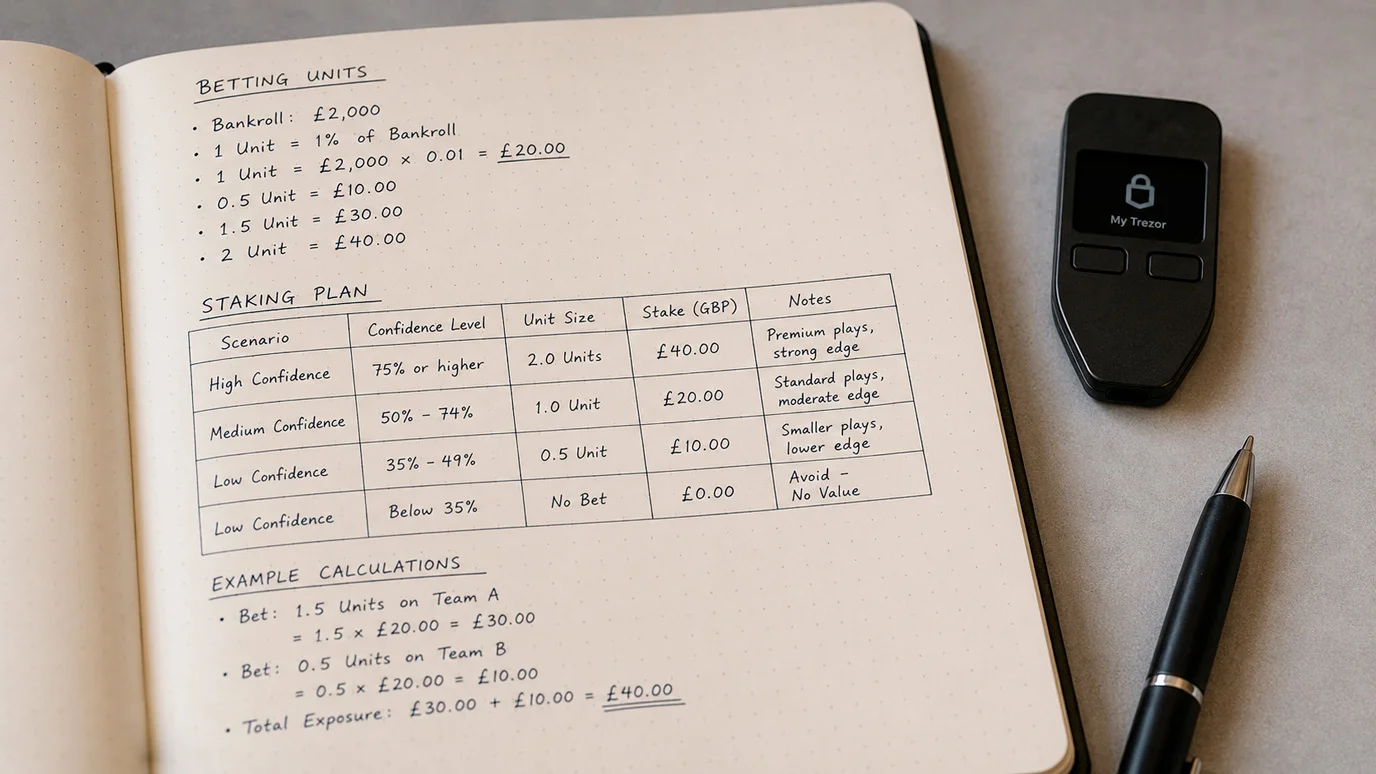
Traditional bankroll management starts with defining a “unit” — typically 1-3% of your total bankroll per wager. If your bankroll is 10,000 pounds, one unit is 100-300 pounds. Simple enough in a fiat denomination where the value is stable. But crypto bettors face a moving target: your bankroll’s fiat value changes with every BTC or ETH price movement, which means your unit size in real terms shifts even when you have not placed a bet.
The discipline I have adopted: denominate your bankroll in your chosen crypto, define units in that denomination, and rebalance the fiat-equivalent calculation weekly. If your bankroll is 1 BTC and you set a unit at 2% (0.02 BTC), your unit stays 0.02 BTC regardless of whether Bitcoin is at 25,000 or 35,000 pounds that week. This approach keeps your betting strategy consistent and prevents the psychological trap of “feeling rich” when crypto prices rise, leading to oversized bets.
Stablecoin-denominated bankrolls sidestep this entirely. If your bankroll is 5,000 USDT, one unit at 2% is 100 USDT, and that represents roughly 80 pounds today, tomorrow, and next month. The stability enables the same disciplined unit sizing that a fiat bettor practises, which is one reason stablecoins are projected to handle over 70% of crypto betting transactions by 2026. For bettors who find volatile-denomination staking plans mentally taxing, the stablecoin route removes a variable that should not be influencing wagering decisions.
The Kelly Criterion and Crypto Bankroll Dynamics
Experienced bettors know the Kelly Criterion — a formula that calculates the optimal bet size based on your edge and the odds offered. Full Kelly is aggressive; most professionals use fractional Kelly (half or quarter) to reduce variance. The formula works identically with crypto stakes as with fiat, but the input — your estimated edge — becomes harder to assess when the sportsbook’s line might be less efficient than at a regulated platform.
Crypto sportsbooks operate across a spectrum of odds quality. Some post razor-sharp lines that reflect the global consensus. Others set lines independently with wider margins or occasional mispricings. If you are calculating Kelly-optimal stakes against odds that are already less efficient, your perceived edge may be larger than it actually is after accounting for the sportsbook’s wider vig. Overstating your edge leads to overbetting — the exact mistake the Kelly Criterion is designed to prevent.
My practical application: I use quarter-Kelly for all NFL bets at crypto sportsbooks and half-Kelly only at platforms where I have verified that the lines track closely with the sharp market consensus. This conservative approach sacrifices theoretical growth rate for survival rate, and across a 23-week season, survival is the priority. No bankroll management formula helps if you are busted by Week 8.
Multi-Platform Bankroll Allocation
Most serious crypto NFL bettors maintain balances at multiple sportsbooks to exploit odds discrepancies. This creates an allocation decision: how do you distribute your total bankroll across platforms?
The answer depends on counterparty risk tolerance. Offshore crypto sportsbooks — which account for effectively all crypto-accepting operators available to UK bettors — carry non-trivial counterparty risk. An operator can freeze withdrawals, impose new terms, or disappear entirely. The 1.5 million UK users placing roughly 10 billion pounds annually on unlicensed sites collectively absorb this risk, and individual losses from platform failures are not uncommon.
I allocate no more than 25% of my total NFL betting bankroll to any single crypto sportsbook. The remaining funds sit in a personal hardware wallet, with transfers made weekly based on where I plan to place that week’s wagers. This limits my maximum loss from a single platform failure to a quarter of my bankroll — painful but survivable. Bettors who keep their entire bankroll at one offshore platform are staking their survival on a single operator’s integrity and solvency, which is a risk that no edge in handicapping can offset.
Network fees affect allocation strategy too. If you are distributing funds across four sportsbooks via on-chain Bitcoin, four deposits and four withdrawals per week cost $8-120 in fees depending on congestion. Using USDT on TRC-20 reduces the total to under $1. The fee difference across a full season is hundreds of pounds — effectively a tax on your multi-platform strategy that eats into the edge you are trying to exploit through line shopping.
Surviving Cold Streaks and Emotional Discipline
Every NFL bettor hits losing stretches. A 5-10 record across two weeks is perfectly normal variance even for a bettor with a genuine long-term edge. The crypto environment makes these stretches psychologically harder because the sportsbook’s frictionless deposit process enables impulse topping-up. I have caught myself reaching for my wallet to fund a “revenge” deposit after a bad Sunday more times than I would like to admit.
The structural defence against this is pre-season budgeting. Before Week 1, I define my total NFL season bankroll, allocate it across platforms, and commit to not adding fresh capital regardless of how the season unfolds. If my bankroll depletes to zero, the season is over. That hard ceiling prevents the chase pattern — increasing stakes to recover losses — that destroys more sports bettors than any other single behaviour.
Crypto’s 24/7 market availability compounds the discipline challenge. A fiat bettor who closes their laptop at midnight cannot deposit until the next session. A crypto bettor can deposit at 3am after a particularly frustrating Monday Night Football loss. Removing your sportsbook bookmarks from your phone, keeping your hardware wallet in a separate room, and setting a 24-hour cooling-off rule after any losing session create friction that mimics the protective barriers of a more traditional betting environment. The 83.6% surge in crypto betting wagers since mid-2022 includes plenty of volume driven by impulsive deposits, and your bankroll management framework should account for the human being operating within it, not just the mathematical ideal.
What percentage of my crypto bankroll should I bet per NFL game?
Standard practice is 1-3% of your total bankroll per wager. Conservative bettors use 1% (one unit); more aggressive but experienced bettors may go to 3% on their highest-confidence plays. Anything above 5% per wager significantly increases the risk of bankroll depletion during the inevitable losing streaks that occur across a 23-week NFL season.
Should I keep my entire betting bankroll at one crypto sportsbook?
No. Distributing your bankroll across multiple platforms limits your maximum loss from a single operator failure. A reasonable ceiling is 25% of your total bankroll at any one sportsbook. The remaining funds should be held in a personal wallet, with transfers made as needed for each week’s wagers. This approach balances convenience with counterparty risk management.
Learn more about crypto nfl betting on our main page.
You may also find Crypto NFL Betting Bonuses: Structures, Wagering Terms, and Red Flags interesting.
Written by the editors at Crypto nfl Betting.