NFL Bet Types at Crypto Sportsbooks: Spreads, Props, Futures, and More
 Available in US
Table of Contents
- Moneyline Bets: Picking the Winner
- Point Spread Bets: Handicapping the Margin
- Totals (Over/Under): Scoring-Based Wagers
- NFL Prop Bets with Crypto: Player and Game Props
- Futures and Outrights: Season-Long NFL Markets
- Parlays and Accumulators at Crypto Sportsbooks
- Reading Odds: Fractional, Decimal, and American Formats
- Frequently Asked Questions

When I first started betting on the NFL with crypto back in 2017, the menu was laughably thin. Moneyline, a basic spread, maybe a total. That was it. Try finding a Patrick Mahomes passing yards prop at a Bitcoin sportsbook in those days and you would get a blank screen. Fast forward to 2026, and the NFL generates around 30 billion dollars in legal wagering volume per season — a figure that has pulled crypto sportsbooks into a market depth arms race with their fiat-licensed competitors. The bet types available at today’s crypto platforms would have been unrecognisable even five years ago.
This guide walks through every major NFL bet type you will encounter at a crypto sportsbook, with examples using fractional odds (the UK standard) and explanations pitched at someone who understands football but may be newer to the mechanics of wagering. If you already know your spreads from your totals, the crypto-specific nuances — how live in-play markets interact with blockchain settlement, how parlays are structured differently at decentralised platforms — are where this gets interesting.
Moneyline Bets: Picking the Winner
The moneyline is the oldest bet in football and the first one most UK punters place. You pick which team wins. No point margins, no scoring thresholds — just the final result.
At a crypto sportsbook, a typical NFL moneyline might look like this: Kansas City Chiefs 4/9, Denver Broncos 7/4. The Chiefs at 4/9 means you stake 9 pounds (or the BTC equivalent) to win 4, plus your stake back — a 13-pound return on a 9-pound bet. Denver at 7/4 means a 4-pound stake returns 7 in profit plus the original 4, totalling 11. The shorter the odds, the more the market expects that team to win. The longer the odds, the higher the reward for backing the underdog.
What makes moneyline betting different at crypto sportsbooks is margin structure. Traditional UK bookmakers build their margin — the overround, or “vig” — into the odds across both sides of the market. A typical overround on an NFL moneyline at a major UK bookmaker sits between 4% and 6%. Crypto sportsbooks, particularly those operating with lower overhead and no physical retail presence, sometimes run thinner margins — 2% to 4% on headline NFL games. That difference compounds over a full season of bets. If you are placing 50 moneyline bets between September and February, a 2% margin advantage is not trivial.
The catch is liquidity. Major UK bookmakers will accept moneyline bets of several thousand pounds on a primetime NFL game without blinking. Some crypto sportsbooks cap moneyline stakes at lower levels, particularly for sharp or winning accounts. I have had limits imposed within weeks of opening accounts at two different platforms — not because I was doing anything unusual, but because consistent winning on moneylines triggers risk management systems that offshore operators apply aggressively.
One more thing UK bettors should understand about NFL moneylines: ties almost never happen. The NFL uses overtime rules that make draws exceedingly rare in the regular season and impossible in the playoffs. This is different from football (soccer), where the draw is a frequent outcome and the three-way market is standard. Most NFL moneylines are two-way markets. When a crypto sportsbook lists a third option for a draw, the odds are typically 50/1 or longer, reflecting the extreme rarity of the outcome.
Point Spread Bets: Handicapping the Margin
If moneylines are about who wins, spreads are about how much they win by. The point spread — or handicap, in UK betting terminology — levels the playing field by giving the underdog a virtual head start.
Here is how it works in practice. Say the Buffalo Bills are 6.5-point favourites against the Miami Dolphins. The sportsbook lists Bills -6.5 and Dolphins +6.5, both typically priced at 10/11 (or close to even money). If you back the Bills at -6.5, they need to win by 7 or more points for your bet to pay. If you take the Dolphins at +6.5, Miami can lose by up to 6 points and your bet still wins. The half-point eliminates the possibility of a push (a tie against the spread), ensuring every bet resolves as a winner or loser.
Spread betting dominates NFL wagering in the US — it is the bread and butter of American football gambling culture. UK punters familiar with Asian handicaps in football (soccer) will find the concept immediately intuitive. The numbers are larger in the NFL because scoring happens in increments of 3 (field goals) and 7 (touchdowns with extra points), creating natural clusters around key numbers like 3, 7, 10, and 14. Experienced spread bettors pay close attention to these key numbers because a half-point movement across 3 or 7 changes the outcome frequency more than the same movement elsewhere on the line.
At crypto sportsbooks, spreads are typically offered with the same level of detail as fiat platforms. The difference, again, is in the margins. I have seen spread prices of 10/11 on both sides at crypto sportsbooks where equivalent UK bookmakers priced the same game at 5/6 on both sides. The crypto price gives you slightly better value per bet. Over a 17-week NFL regular season with multiple games per week, that edge matters. The deeper analysis of spread mechanics, including ATS (against the spread) records and line movement patterns, lives in my dedicated NFL parlay builder piece, where multi-leg spread bets come into play.
Totals (Over/Under): Scoring-Based Wagers
I once placed a bet on Over 51.5 in a Bills-Chiefs playoff game and watched the two teams combine for 25 points in the first half. By halftime I was mentally spending the winnings. They finished with 49 combined. Totals bets teach humility fast.
The concept is straightforward: the sportsbook sets a number representing the expected combined score of both teams, and you bet whether the actual total will be over or under that number. A typical NFL regular-season total sits between 40.5 and 52.5, depending on the teams involved. A defensive grudge match between two run-heavy teams might open at 37.5. A shootout between elite quarterbacks could open at 53.5.
Totals are popular among bettors who have a strong read on how a game will play out stylistically but less confidence about which team wins. They also interact well with live betting — the fastest-growing segment of the betting market, now accounting for 53.4% of all wagering activity globally. As a game unfolds, the live total adjusts in real time. If the first quarter produces 21 points, the live total for the remainder of the game shifts dramatically, creating opportunities for bettors who can read game flow.
At crypto sportsbooks, totals markets are standard across all major platforms. Pricing tends to be competitive with fiat alternatives, and some platforms offer alternate totals — lines set 3 to 10 points above or below the main number, at adjusted odds — that give you more flexibility. Team totals (betting on one team’s score in isolation) are also widely available and useful for NFL games where one side’s offence is significantly stronger but the overall total is inflated by expectations for both teams.
Weather is a factor that UK punters sometimes overlook with totals. Outdoor NFL games in December and January — the business end of the season — can be played in snow, rain, or sub-zero temperatures that suppress scoring. If you are betting from the UK and the game is in Green Bay or Buffalo in late December, check the forecast before backing an over. Cold weather games consistently trend under their posted totals.
NFL Prop Bets with Crypto: Player and Game Props
Props — short for proposition bets — are where NFL crypto sportsbooks have expanded most dramatically in the past three years. These are wagers on specific events within a game rather than the game’s outcome.
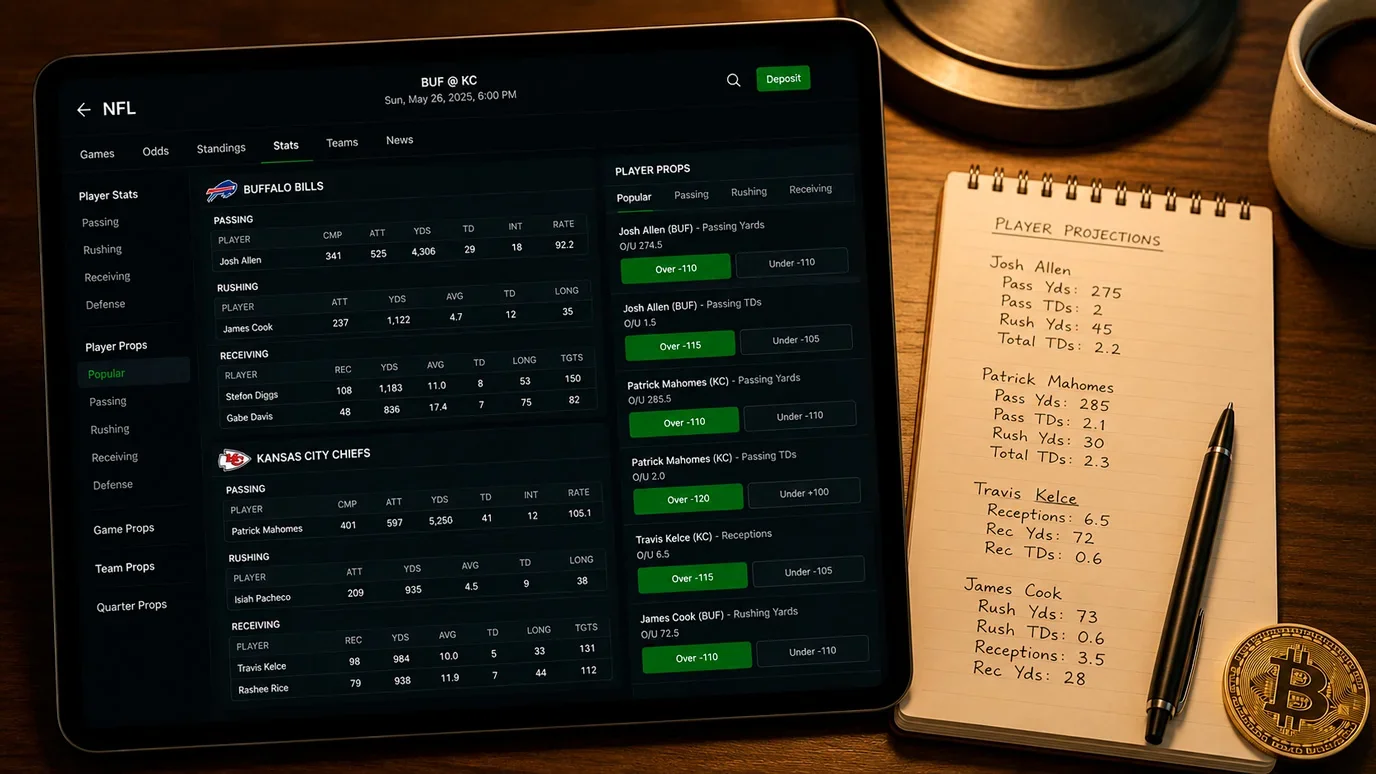
Player props focus on individual performance. Will the quarterback throw over or under 275.5 passing yards? Will the running back score a touchdown? How many receptions will the tight end have? The numbers are set by the sportsbook based on the player’s season averages, matchup data, and projected game script. A quarterback facing a porous secondary might have his passing yards line set higher than his season average, reflecting the expected opportunity.
Game props cover events that do not depend on any single player. Will the first score be a touchdown or a field goal? Will there be a safety? How many total sacks in the game? These tend to carry wider margins because the outcomes are harder to model precisely, but they also attract less sharp money, which means the lines can be softer — more exploitable for bettors who do their research.
The Super Bowl takes prop betting to its extreme. With a projected wagering handle of 1.76 billion dollars for Super Bowl LX in 2026, the prop menu for the championship game dwarfs anything available during the regular season. You can find props on the length of the national anthem, the colour of the Gatorade shower, and hundreds of player performance markets that would never exist for a Week 6 game. Crypto sportsbooks have embraced this prop explosion enthusiastically — it drives engagement and deposits during the two-week build-up to the game.
The crypto-specific wrinkle with props is settlement timing. At fiat bookmakers, prop bets settle within minutes of the relevant event occurring. At some crypto sportsbooks, particularly decentralised ones, settlement depends on oracle feeds — external data sources that confirm the outcome on-chain. If the oracle has a delay, your winning player prop might not settle for 30 minutes to several hours after the game ends. This is improving, but it is worth understanding that “instant settlement” at crypto platforms does not always mean what you think it does.
Futures and Outrights: Season-Long NFL Markets
Futures bets are placed months before the outcome is decided. Who will win the Super Bowl? Which player will be named MVP? Which team wins the AFC East? The odds are long, the payouts are large, and the money is locked up for the entire season.
That last point — locked-up money — takes on a different dimension when you are betting with crypto. A futures bet placed in July with 0.05 BTC might be worth 3,000 pounds at the time of the wager. By February, when the Super Bowl settles the bet, that same 0.05 BTC could be worth 4,500 pounds or 1,800 pounds depending on Bitcoin’s price movement. You are making two bets simultaneously: one on the NFL outcome and one on Bitcoin’s trajectory. Some bettors see this as an opportunity; I see it as an unmanaged variable that most people do not price in when they are excited about a 25/1 Super Bowl winner.
The practical mitigation is stablecoins. Placing futures bets in USDT or USDC eliminates the crypto volatility component, letting you isolate the NFL prediction without the currency risk. Not all crypto sportsbooks offer stablecoin-denominated futures markets, but the ones that do are increasingly popular among serious bettors who understand the compounding risk problem.
Futures markets at crypto sportsbooks have improved substantially. Most major platforms now offer Super Bowl winner, conference winner, division winner, regular season win totals, and MVP markets from the moment the previous season ends. Some add coaching hire markets, draft position props, and schedule-related futures as the offseason progresses. The liquidity is thinner than at major UK bookmakers — you will not get a 5,000-pound equivalent futures bet accepted at most crypto platforms — but for stakes under 500 pounds equivalent, the coverage is comparable.
One timing advantage for UK bettors: because crypto sportsbooks operate globally and update lines around the clock, you can often find early-season futures prices before the UK-facing traditional bookmakers have posted their NFL markets. I have placed conference winner bets in March at crypto sportsbooks that were not available at UK bookmakers until May. Getting in early at longer odds is one of the few structural advantages that crypto platforms offer on futures.
Parlays and Accumulators at Crypto Sportsbooks
In the UK we call them accumulators. In the US they are parlays. Same concept: multiple selections combined into a single bet, where every leg must win for the bet to pay out. The appeal is obvious — small stakes, potentially massive returns. The reality is that parlays are where sportsbooks make their best margins, because the probability of hitting every leg drops exponentially with each addition.
A two-team NFL parlay at 10/11 per leg pays roughly 2.6/1. A three-team parlay pays around 6/1. A four-teamer hits 12/1. By the time you are combining six or seven legs — which same-game parlay builders actively encourage — the true probability of winning is low enough that even generous-looking odds include a significant house edge. NFL betting generates more single-game handle in a single Sunday slot than entire weeks of MLB or NBA action, and a meaningful portion of that volume flows through parlay bets.
Crypto sportsbooks have leaned heavily into parlay builders, particularly same-game parlays (SGPs) that combine multiple markets within a single NFL match. Pick the game winner, the over/under, a player prop, and the first touchdown scorer — all in one bet. The platforms present this as an exciting feature. It is also a high-margin product where the correlations between legs (a team winning and its quarterback throwing for more yards, for example) are priced in the house’s favour more than most bettors realise.
My advice on parlays at crypto sportsbooks is the same as at any other: treat them as entertainment with a small stake allocation, not as a core betting strategy. The payout ceiling is thrilling. The hit rate is brutal. If you want to explore parlay mechanics in depth — including how same-game parlay pricing works and where the hidden margins sit — I have a dedicated breakdown that goes much further into the maths.
Reading Odds: Fractional, Decimal, and American Formats
This section exists because I have watched too many UK bettors stare at a crypto sportsbook screen showing “-110” next to an NFL spread and have no idea what it means. Odds formats are a regional language barrier, and most crypto sportsbooks default to American format because their primary market is North American.
Fractional odds are the UK standard. 7/4 means you win 7 for every 4 you stake. 1/2 means you win 1 for every 2 staked. The first number is profit; the second is stake. If you grew up with William Hill on the high street, this is second nature.
Decimal odds are the European standard and increasingly common at international sportsbooks. They represent your total return per unit staked, including the stake itself. Decimal 2.75 is the same as fractional 7/4 — a 1-pound bet returns 2.75 pounds total (1.75 profit plus the 1-pound stake). Decimal odds make parlay calculations simpler: multiply the decimals together to get the combined odds.
American odds are the format you will see most often at crypto sportsbooks. They use a baseline of 100 and split into positive and negative numbers. Positive odds (+175) tell you how much profit you make on a 100-unit stake — so +175 means 175 profit on 100 staked, equivalent to 7/4 fractional. Negative odds (-110) tell you how much you need to stake to win 100 — so -110 means staking 110 to win 100 profit, roughly equivalent to 10/11 fractional. The minus sign indicates the favourite; the plus sign indicates the underdog.
The good news: virtually every crypto sportsbook lets you switch odds formats in the settings. Look for a toggle labelled “odds format” or “display preferences.” Set it to fractional or decimal — whichever you are comfortable with — and the entire platform adjusts. Bill Miller of the American Gaming Association described the Super Bowl as the event that brings fans together like no other, and when 1.76 billion dollars is being wagered on a single game, the odds format you read those markets in should be the one that lets you make decisions without mental arithmetic slowing you down.
If you find yourself needing a quick conversion: American -150 is roughly 2/3 fractional (or 1.67 decimal). American +200 is 2/1 fractional (3.00 decimal). American -110, the standard spread price, is just under 10/11 fractional (1.91 decimal). Memorising these three anchors covers about 80% of the NFL lines you will encounter. For everything else, the settings toggle is your friend.
Frequently Asked Questions
Which NFL bet type offers the best value at crypto sportsbooks?
Point spread bets and totals tend to offer the thinnest margins at crypto sportsbooks, often 2% to 4% compared to 4% to 6% at traditional UK bookmakers. Moneylines on heavily favoured teams carry wider margins because the short odds amplify the house edge. Prop bets and parlays generally have the highest built-in margins, making them better suited for entertainment stakes than for serious value betting.
Are prop bet markets different at crypto sportsbooks compared to traditional UK bookmakers?
The types of props available are broadly similar — player performance markets, game events, and scoring props. The difference is in market depth and settlement. Crypto sportsbooks sometimes offer a wider range of exotic props, particularly for high-profile games like the Super Bowl. Settlement at decentralised crypto platforms may take longer than at fiat bookmakers due to oracle feed delays confirming on-chain results.
Can I place NFL futures bets with USDT or Ethereum?
Yes, most major crypto sportsbooks accept USDT and Ethereum for futures bets alongside Bitcoin. Placing futures with a stablecoin like USDT is a practical way to avoid the compounding volatility risk that comes with having funds locked up for months in a volatile cryptocurrency while waiting for the NFL season to resolve.
How do crypto sportsbooks display NFL odds for UK users?
Most crypto sportsbooks default to American odds format because their primary market is North American. However, virtually all platforms allow you to switch to fractional or decimal odds in the account settings or display preferences. Set this before placing your first bet to avoid confusion when evaluating lines.
Find the best options for crypto nfl betting.
Read our detailed review of Crypto Wallets for NFL Betting: Choosing the Right Type for Sportsbook Deposits.
Prepared by the Crypto nfl Betting editorial staff.