NFL Player Props at Crypto Sportsbooks: Market Depth and Pricing Dynamics
 Available in US
Player props changed the way I bet on the NFL. Six years ago, my NFL wagers were almost entirely spreads and totals — team-level outcomes where the market is razor-sharp and finding an edge requires outperforming the most sophisticated pricing models in sports. Then I started digging into player props at crypto sportsbooks and discovered markets where the inefficiencies were not subtle. A quarterback’s passing yards over/under set 15 yards off my projection. A running back’s reception count priced as if he was still in last season’s offensive scheme after a coaching change. These are the cracks that make props the most interesting market in NFL crypto betting.
Player Prop Markets Available at Crypto Platforms
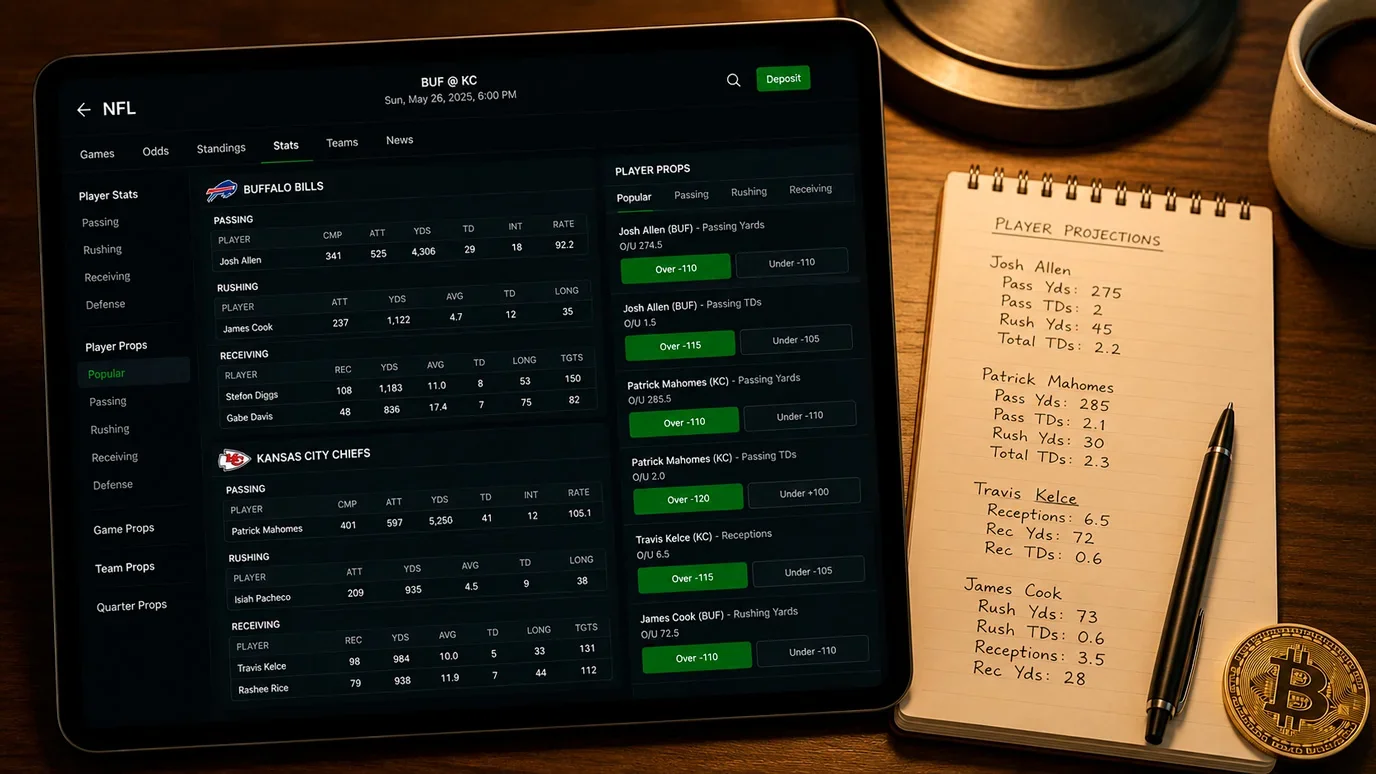
The standard player prop menu at a well-stocked crypto sportsbook covers passing yards, passing touchdowns, rushing yards, receiving yards, receptions, and anytime or first touchdown scorer for every starter in a given game. That baseline is consistent across both crypto and fiat platforms. Where crypto sportsbooks differentiate is in the secondary and tertiary markets.
Quarterback props go deep: completions, interceptions, longest completion, sacks taken, rushing yards (increasingly relevant in today’s mobile-QB era). Some crypto platforms offer “exact” props — will this quarterback throw exactly 2 touchdowns? — with correspondingly longer odds. These exact markets carry high variance but appeal to bettors who have identified a specific game script they expect to unfold.
Defensive and special teams props remain thinner at crypto platforms than at the sharpest US-regulated sportsbooks. Total tackles, interceptions by a specific player, and sack counts for individual defenders are available but often with lower limits and wider vig. The limited liquidity on defensive props reflects both lower demand and the difficulty of modelling individual defensive statistics, which carry higher variance than offensive outputs.
The American football betting market’s growth to $9.5 billion in 2026 has expanded prop offerings at every level. Where a crypto sportsbook might have offered 30-40 player props per game three years ago, the number now exceeds 100 at the more established platforms. That depth creates more opportunities for line-shopping between operators, as each sportsbook’s prop pricing reflects its own modelling inputs and risk tolerances.
Pricing Inefficiencies in Crypto Prop Markets
Props are the least efficient market in sports betting because they require granular, player-level modelling that sportsbooks invest in unevenly. The main game spread for Chiefs vs Ravens reflects the combined intelligence of the sharpest bettors and the most sophisticated models in the world. The over/under on a Chiefs tight end’s receiving yards reflects a far smaller pool of analytical input.
Crypto sportsbooks amplify these inefficiencies in several ways. First, they receive less sharp action than major regulated platforms. The professional bettors who quickly correct mispricings in the US regulated market do not always operate at offshore crypto sportsbooks — jurisdictional friction, withdrawal delays, and counterparty risk deter some of the sharpest money. Lines that would be corrected within minutes at a DraftKings or FanDuel can persist for hours at a crypto operator.
Second, the prop lines at crypto sportsbooks are sometimes sourced from a single odds feed rather than generated by an in-house modelling team. If that feed is slow to incorporate breaking information — a key player downgraded to questionable on the Friday injury report, a coaching change affecting play-calling tendencies — the lines sit stale while the true probability has shifted. I have exploited this lag repeatedly by pairing real-time NFL injury reporting with crypto sportsbook prop lines that have not yet adjusted.
Correlation between props creates another angle. If a team is expected to throw heavily in a game (because they are a heavy underdog chasing from behind), the quarterback’s passing yards, the wide receivers’ receptions, and the running back’s rushing yards are all correlated to that game script. Sportsbooks price individual props in isolation, which means a bettor who identifies the likely game script can find clusters of value across related player markets in the same game — a technique that works regardless of whether you play them as singles or combine them into same-game parlays.
Building a Player Prop Approach for Crypto Sportsbooks
My prop workflow starts with team-level analysis: expected game script, pace of play, defensive matchup strengths and weaknesses. From there, I project individual player outputs using a combination of season-long averages, recent-form weighting, and matchup-specific adjustments. The projection becomes a line, and I compare my line to the sportsbook’s posted number. If the gap exceeds a threshold I have calibrated over several seasons, the bet qualifies.
The threshold matters because props carry wider vig than spreads or totals. A standard spread might be juiced at -110/-110 (4.5% hold). A player prop at a crypto sportsbook might be -115/-115 (5.7% hold) or even -120/-110 (asymmetric vig). That wider margin means your edge needs to be proportionally larger to overcome the house take. I do not bet a prop unless my projected line differs from the sportsbook’s by at least 7-10%, which filters out marginal spots where the vig eats the edge.
Volume matters for a different reason in crypto prop markets. If you are betting props at lower limits — and crypto sportsbooks often cap prop wagers lower than spread or total bets — you need more bets to generate meaningful volume. Placing 15-20 prop bets per week at modest stakes can produce a higher expected profit than 3-4 larger spread bets, because the sum of small edges across many inefficient markets outpaces a single edge in a highly efficient one. The low transaction fees in the crypto environment, particularly on TRC-20 or Lightning Network, make this high-frequency, low-stake approach economically viable.
Record-keeping is non-negotiable. Track every prop bet with the posted line, your projected line, the stake, and the result. After a full NFL season, the data tells you which prop types (passing yards, receptions, touchdowns) and which positions (quarterback, wide receiver, running back) produce your strongest results. That feedback loop is the difference between a bettor who thinks they have an edge and one who has measured it. Crypto betting wagers have surged 83.6% since mid-2022, and the bettors who thrive in this growing market are the ones treating it with analytical rigour rather than gut feel.
Do crypto sportsbooks offer more NFL player props than traditional bookmakers?
Crypto sportsbooks typically offer comparable or slightly greater depth in NFL player props compared to UKGC-licensed operators, particularly in exotic markets like exact touchdown counts, longest play yardage, and defensive player props. The key difference is that props at crypto sportsbooks may carry less efficient pricing due to lower sharp action, creating potential value opportunities.
What is the best strategy for betting NFL player props at crypto sportsbooks?
Build projections for individual player outputs based on game script analysis, defensive matchups, and recent form. Compare your projections to the sportsbook’s lines and bet only when the discrepancy exceeds 7-10% to account for the wider vig on props. Track results across the full season to identify which prop types produce your strongest edge and refine your approach accordingly.
Find the best options for crypto nfl betting.
Read our detailed review of Provably Fair NFL Betting: How On-Chain Verification Works.
Published by the Crypto nfl Betting team.