Bitcoin NFL Betting: Deposits, Withdrawals, and Network Comparisons
 Available in US
Table of Contents
- How to Deposit Bitcoin at an NFL Crypto Sportsbook
- Bitcoin Networks Compared: On-Chain, Lightning, and Wrapped BTC
- Withdrawal Timelines: What to Expect by Network
- Fees and Hidden Costs in Crypto NFL Betting Transactions
- Fiat vs Bitcoin Transactions at Sportsbooks: A Side-by-Side Look
- Converting NFL Crypto Winnings to GBP
- Frequently Asked Questions
My first Bitcoin deposit at a crypto sportsbook took 47 minutes to confirm. I sat there refreshing the page like it was a flight departure board, watching the transaction crawl through the mempool while the NFL game I wanted to bet on kicked off without me. That was 2019, and I was using the main Bitcoin network during a fee spike. Today, the same deposit on the Lightning Network takes under ten seconds. The technology has changed dramatically, but the confusion around it has not.
Bitcoin still dominates crypto sportsbook transactions — it accounts for roughly 66% of all crypto gambling volume globally, with Ethereum at 9% and Litecoin at 6%. Yet most guides aimed at UK NFL bettors treat the deposit process as a single paragraph: “send BTC to the address provided.” That glosses over the network choices, fee structures, confirmation times, and conversion mechanics that determine whether your deposit experience is seamless or maddening. Mobile devices now generate 80% of all online betting activity, and the intersection of mobile wallets, QR codes, and blockchain confirmations adds another layer of practical complexity that nobody seems to want to discuss in detail.
This guide does. I am going to walk through every stage of the Bitcoin deposit and withdrawal lifecycle at a crypto sportsbook — the networks, the fees, the timelines, the hidden costs, and the practical steps for converting your winnings back to pounds sterling. If you are betting on the NFL from the UK with Bitcoin, this is the mechanical knowledge that separates a smooth experience from a frustrating one.
How to Deposit Bitcoin at an NFL Crypto Sportsbook
The process looks deceptively simple on paper. In practice, there are five decision points where things can go wrong, and three of them happen before your Bitcoin even leaves your wallet.
Step one is selecting the right wallet. You need a non-custodial wallet — one where you control the private keys — or a custodial exchange wallet where you hold your BTC. For NFL betting from the UK, the practical choice is usually between a mobile wallet like BlueWallet or Muun (which support both on-chain and Lightning transactions) and a major exchange like Kraken or Coinbase (which offer direct withdrawals to external addresses). The wallet choice determines your available networks, your fee options, and how quickly you can move funds.
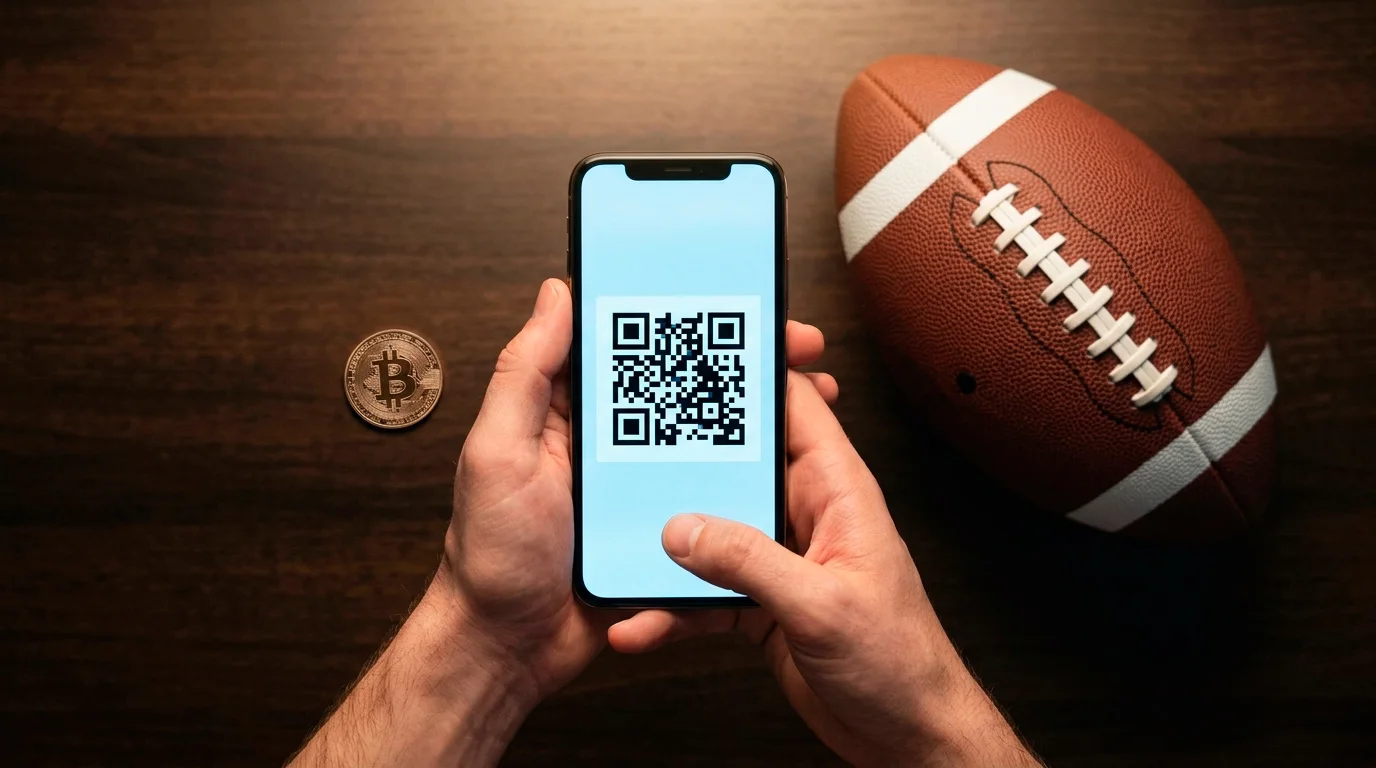
Step two is navigating to the sportsbook’s deposit page and selecting Bitcoin. The platform will generate a unique deposit address — a long alphanumeric string or a QR code. This address is specific to your account and usually valid for a limited time, typically 15 to 30 minutes. Copy it exactly. A single wrong character sends your Bitcoin to an unrecoverable address, and blockchain transactions are irreversible. I cannot stress this enough: triple-check the first four and last four characters of the address before confirming.
Step three is choosing your network, and this is where most new users stumble. If the sportsbook supports Lightning, you will see a Lightning invoice — a different format from a standard Bitcoin address, usually starting with “lnbc” and accompanied by a QR code. If it only supports on-chain Bitcoin, you will see a standard address starting with “bc1” or “1” or “3”. Some platforms offer both and let you choose. The network you select here determines your confirmation time (seconds for Lightning, 10 to 60 minutes for on-chain) and your transaction fee (fractions of a penny for Lightning, potentially several pounds for on-chain during busy periods).
Step four is setting the transaction fee, assuming you are going on-chain. Most wallets let you choose between economy, standard, and priority fee tiers. During the NFL regular season, Sunday afternoons in the US (evening in the UK) tend to coincide with higher Bitcoin network activity. I have found that setting a mid-priority fee around 18:00 GMT on a Sunday typically confirms within 20 to 30 minutes — fast enough for pre-game bets but not for live wagering. If you need speed, use Lightning or deposit earlier in the day when fees are lower.
Step five is confirming the transaction in your wallet and waiting. On-chain deposits typically require one to three network confirmations before the sportsbook credits your account. At roughly ten minutes per confirmation, that is 10 to 30 minutes under normal conditions. Lightning deposits credit within seconds of the payment being routed. Once the funds appear in your sportsbook balance, they are denominated in BTC (or converted to a fiat equivalent, depending on the platform’s setup) and ready for wagering.
Bitcoin Networks Compared: On-Chain, Lightning, and Wrapped BTC
Three years ago, “Bitcoin deposit” meant one thing: an on-chain transaction on the main Bitcoin network. Today, the same phrase can mean three fundamentally different technologies, and the one you choose affects everything from speed to cost to security.
On-chain Bitcoin is the original. Your transaction is broadcast to the entire network, validated by miners, and recorded permanently on the blockchain. It is the most secure and widely supported option — virtually every crypto sportsbook accepts on-chain BTC. The trade-off is speed and cost. Confirmation times fluctuate with network demand, ranging from 10 minutes during quiet periods to over an hour during congestion spikes. Fees follow the same pattern: I have paid as little as 0.50 pounds and as much as 12 pounds for a single deposit, depending on timing. For NFL bettors placing pre-game wagers well before kick-off, on-chain works fine. For anything time-sensitive, it is a liability.
The Lightning Network is a Layer 2 protocol that sits on top of Bitcoin. Transactions happen off-chain through payment channels, settling instantly and costing fractions of a penny. The practical experience is transformative — you scan a QR code, confirm in your wallet, and the funds appear in your sportsbook account before you can switch apps. Lightning is ideal for live NFL betting, where odds shift by the minute and a 20-minute deposit window means missed opportunities. The limitation is adoption. Not all crypto sportsbooks support Lightning yet, and those that do sometimes impose lower deposit limits on Lightning transactions compared to on-chain.
Wrapped Bitcoin (WBTC) is BTC represented as an ERC-20 token on the Ethereum blockchain. A few crypto sportsbooks accept WBTC alongside native ETH deposits. The advantage is that WBTC can interact with Ethereum-based smart contracts, which matters for decentralised sportsbook platforms. The disadvantage is that you inherit Ethereum’s gas fees — often higher than Bitcoin on-chain fees — and you add a trust layer, since WBTC requires a custodian to hold the underlying Bitcoin. For most UK NFL bettors, WBTC is a niche option. Unless you are already operating within the Ethereum ecosystem and want to avoid the BTC-to-ETH conversion step, native Bitcoin (on-chain or Lightning) is more practical.
Withdrawal Timelines: What to Expect by Network
Deposits get all the attention. Withdrawals are where the real friction lives.
The withdrawal process at a crypto sportsbook has two stages, and only one of them involves the blockchain. The first stage is internal processing — the time between you hitting “withdraw” and the sportsbook broadcasting the transaction to the network. This is entirely controlled by the operator, not the technology, and it varies wildly. Some platforms process withdrawal requests within minutes on an automated basis. Others batch withdrawals every few hours. A handful still require manual review, which can add 12 to 24 hours, particularly for larger amounts that trigger internal compliance checks.
The second stage is the blockchain confirmation itself. For on-chain Bitcoin withdrawals, expect 10 to 60 minutes depending on the fee the sportsbook attaches. Most operators set a standard fee that targets confirmation within 30 minutes — they are not going to pay premium fees to rush your withdrawal. For Lightning withdrawals, the second stage is essentially instant once the operator initiates it, which makes the internal processing time the real bottleneck. If a sportsbook batches Lightning withdrawals hourly, you are waiting 60 minutes regardless of Lightning’s sub-second settlement capability.
From my own tracking across multiple platforms over the past two years, the median total withdrawal time — from button press to BTC appearing in my wallet — breaks down roughly like this. Lightning-enabled platforms with automated processing: 5 to 15 minutes. On-chain with automated processing: 30 to 90 minutes. On-chain with manual review: 2 to 24 hours. These figures assume standard conditions — no compliance holds, no network congestion events, no weekend processing delays. Around 40% of online betting platforms now accept crypto deposits, but withdrawal support and speed remain inconsistent. Always check a platform’s withdrawal policy before depositing, not after.
One timing pattern I have noticed over multiple NFL seasons: withdrawal processing tends to slow down on Sunday nights and Monday mornings GMT, which coincides with the heaviest NFL betting window. Whether that is due to manual review backlogs, risk management holds on winning accounts, or simply higher transaction volumes, the effect is real. If you are planning to withdraw after a Sunday slate of NFL games, initiating the withdrawal before midnight rather than waiting until Monday tends to shave a few hours off the total time.
Fees and Hidden Costs in Crypto NFL Betting Transactions
Ask a crypto sportsbook about fees and you will hear “zero deposit fees” repeated like a mantra. That claim is technically accurate and practically misleading. The sportsbook may not charge you a deposit fee, but that does not mean your deposit is free.
The first cost is the network fee — the amount you pay miners (on-chain) or routing nodes (Lightning) to process your transaction. On-chain Bitcoin fees are denominated in satoshis per byte of transaction data, not as a percentage of the amount sent. A deposit of 0.01 BTC and a deposit of 1 BTC cost the same network fee if the transaction is the same size. During the 2025 NFL season, I recorded on-chain fees ranging from 1,500 to 45,000 satoshis for standard deposits — roughly 0.80 to 25 pounds depending on Bitcoin’s price and network congestion. Lightning fees were consistently below 100 satoshis, often under 10, making them negligible for any practical deposit size.
The second cost is the exchange rate spread. If you are buying Bitcoin specifically to deposit at a sportsbook, you pay a spread at the exchange — the difference between the buy price and the mid-market rate. Major UK-accessible exchanges charge spreads of 0.1% to 0.5%, plus a transaction fee of 0.1% to 0.6%. On a 200-pound deposit, that is 0.40 to 2.20 pounds in exchange costs before the BTC even leaves the exchange.
The third cost is the one nobody talks about: the withdrawal fee the sportsbook charges to send Bitcoin back to your wallet. Many platforms impose a flat withdrawal fee, commonly 0.0001 to 0.0005 BTC regardless of the withdrawal amount. At current prices, that is 5 to 30 pounds. Some platforms cover withdrawal fees for VIP customers or for withdrawals above a certain threshold. A few charge no withdrawal fee at all but set the network fee to a minimum that exceeds what the blockchain actually requires. Read the fee schedule before you deposit. I have seen platforms where the “free deposits, low fees” marketing concealed withdrawal fees that wiped out a meaningful chunk of modest NFL bet winnings.
Fiat vs Bitcoin Transactions at Sportsbooks: A Side-by-Side Look
I keep a spreadsheet. Every deposit, every withdrawal, every fee, timestamped and categorised — BTC on-chain, BTC Lightning, debit card, bank transfer. After two years of data, the comparison is more nuanced than either the crypto evangelists or the sceptics want to admit.
Speed favours crypto on deposits. A debit card deposit at a UKGC-licensed bookmaker is instant, but so is a Lightning Bitcoin deposit — and on-chain BTC typically arrives faster than a bank transfer, which can take hours or even a working day. Withdrawals are a different story. UK-licensed operators using faster payment systems can return funds to your bank account within two to four hours. Bitcoin on-chain withdrawals are comparable if the sportsbook processes quickly, but slower if they batch. The speed advantage that crypto advocates cite is real for deposits but exaggerated for withdrawals.
Cost is where crypto becomes interesting. A debit card deposit at a UK bookmaker is free — operators absorb the processing cost. A Bitcoin deposit carries network fees. But a fiat withdrawal from an offshore sportsbook often involves international wire transfer charges, currency conversion fees, and delays measured in days. A Bitcoin withdrawal from the same offshore sportsbook arrives in your wallet in minutes to hours with a fixed, predictable fee. For UK punters using offshore crypto sportsbooks specifically because no UKGC-licensed operator accepts BTC, the comparison should be against other offshore fiat withdrawal options — and there, Bitcoin wins decisively.
Chris Elliot of Wiggin has noted that crypto can support a more robust control environment than fiat in some respects, particularly around cash transactions. That observation cuts both ways: the blockchain’s transparency is an advantage for auditability, but the pseudonymous nature of wallet addresses creates identity verification challenges that fiat banking has already solved. Bitcoin’s dominance in crypto gambling (66% of all volume) reflects its liquidity and familiarity, not necessarily its superiority as a payment method. For UK NFL bettors, the practical takeaway is that Bitcoin deposits work well when you plan ahead, use the right network, and factor in the full cost chain — exchange fees, network fees, and withdrawal fees — rather than comparing only the headline “zero deposit fee” against a debit card’s instant-and-free experience.
Converting NFL Crypto Winnings to GBP
You have won your NFL bet. The BTC is sitting in your sportsbook account. Now what? For UK-based bettors, “now what” usually means converting that Bitcoin back to pounds sterling so it can pay rent, buy dinner, or sit in a savings account. This step is where the crypto betting experience meets the traditional financial system, and the seams show.
The most straightforward route is withdrawing to a UK-accessible exchange — Kraken, Coinbase, or Bitstamp are the names that come up most often — and selling for GBP. The process is: withdraw BTC from the sportsbook to your exchange deposit address, wait for confirmations, sell BTC for GBP on the exchange, then withdraw GBP to your UK bank account via Faster Payments. Total time from sportsbook withdrawal to pounds in your bank: typically two to six hours if everything runs smoothly, longer if the sportsbook has manual withdrawal processing or the exchange requires additional verification for the incoming deposit.
The costs accumulate at each step. You pay the sportsbook’s withdrawal fee, then the exchange’s trading fee (0.1% to 0.6% on most platforms), then any GBP withdrawal fee the exchange charges (many now offer free Faster Payments withdrawals, but some still charge 1 to 2 pounds). On a 500-pound equivalent withdrawal, total conversion costs typically land between 3 and 8 pounds. Not catastrophic, but not free either.
An alternative for larger amounts is peer-to-peer selling — platforms that match Bitcoin sellers with GBP buyers directly. The spread is often worse than an exchange, but you avoid the exchange’s trading fee and sometimes achieve faster settlement. I would not recommend P2P for anyone unfamiliar with escrow mechanics, though. The fraud risk is real, and the time cost of finding a reliable counterparty usually outweighs the fee savings.
The elephant in the room is tax. Gambling winnings in the UK are tax-free — HMRC does not levy income tax or capital gains tax on betting profits. But the moment you convert Bitcoin to pounds, you may trigger a capital gains event on any appreciation of the BTC itself, separate from the betting winnings. If you deposited Bitcoin worth 400 pounds, won a bet, and withdrew Bitcoin now worth 600 pounds, the 200-pound gain on the Bitcoin’s value appreciation could be subject to CGT. The mechanics are complex enough that I have written a separate piece on USDT NFL betting as one approach to sidestepping this volatility issue. UK crypto ownership sits at about 8% of the adult population — roughly 4.5 million holders with an average holding around 1,842 pounds — so HMRC’s interest in crypto-to-fiat conversions is only growing.
Frequently Asked Questions
How long does a Bitcoin deposit take to appear at a crypto sportsbook?
It depends on the network. Lightning Network deposits typically credit within seconds. On-chain Bitcoin deposits require one to three network confirmations, which takes 10 to 60 minutes under normal conditions. During periods of high network congestion — common on NFL Sundays during US afternoon hours — on-chain confirmations can take longer. Always check whether the sportsbook supports Lightning if speed matters for your betting timeline.
Which Bitcoin network offers the lowest fees for betting transactions?
The Lightning Network offers the lowest fees by a wide margin — typically fractions of a penny per transaction regardless of the amount sent. On-chain Bitcoin fees fluctuate with network demand and can range from under a pound to over 20 pounds during congestion spikes. For regular NFL betting deposits, Lightning saves meaningful money over a full season compared to on-chain transactions.
Can I withdraw my NFL betting winnings directly to a UK bank account?
Not directly from a crypto sportsbook. You need an intermediary step: withdraw Bitcoin to a UK-accessible cryptocurrency exchange (such as Kraken or Coinbase), sell it for GBP, and then transfer the pounds to your bank account via Faster Payments. The total process takes two to six hours and incurs exchange trading fees plus any sportsbook withdrawal fee.
What happens if I send Bitcoin to the wrong wallet address?
Bitcoin transactions are irreversible. If you send BTC to an incorrect address, there is no chargeback mechanism, no customer service override, and no blockchain feature that can reverse the transfer. The funds are permanently lost unless the owner of the receiving address voluntarily returns them, which is functionally impossible if the address does not belong to a known entity. Always verify the first and last four characters of any deposit address before confirming a transaction.
Discover everything about crypto nfl betting here.
Check out our guide on Converting Crypto Winnings to GBP: Withdrawal Routes and Practical Steps as well.
Written by the editors at Crypto nfl Betting.