Ethereum NFL Betting: Smart Contract Integration and Practical Deposit Guide
 Available in US
Ethereum occupies an unusual position in the crypto betting ecosystem. It commands roughly 9% of total crypto gambling volume — a distant second to Bitcoin’s 66% — yet it underpins more innovation in sports betting infrastructure than any other blockchain. Every meaningful decentralised sportsbook runs on Ethereum or an Ethereum-compatible chain. Every serious smart contract settlement system speaks Solidity. The currency itself may not dominate the deposit ledger, but the technology behind it is reshaping how NFL bets are placed, matched, and settled. I have used ETH for sportsbook deposits since 2018, and the experience has evolved from painful to merely imperfect.
ETH as a Deposit and Withdrawal Currency
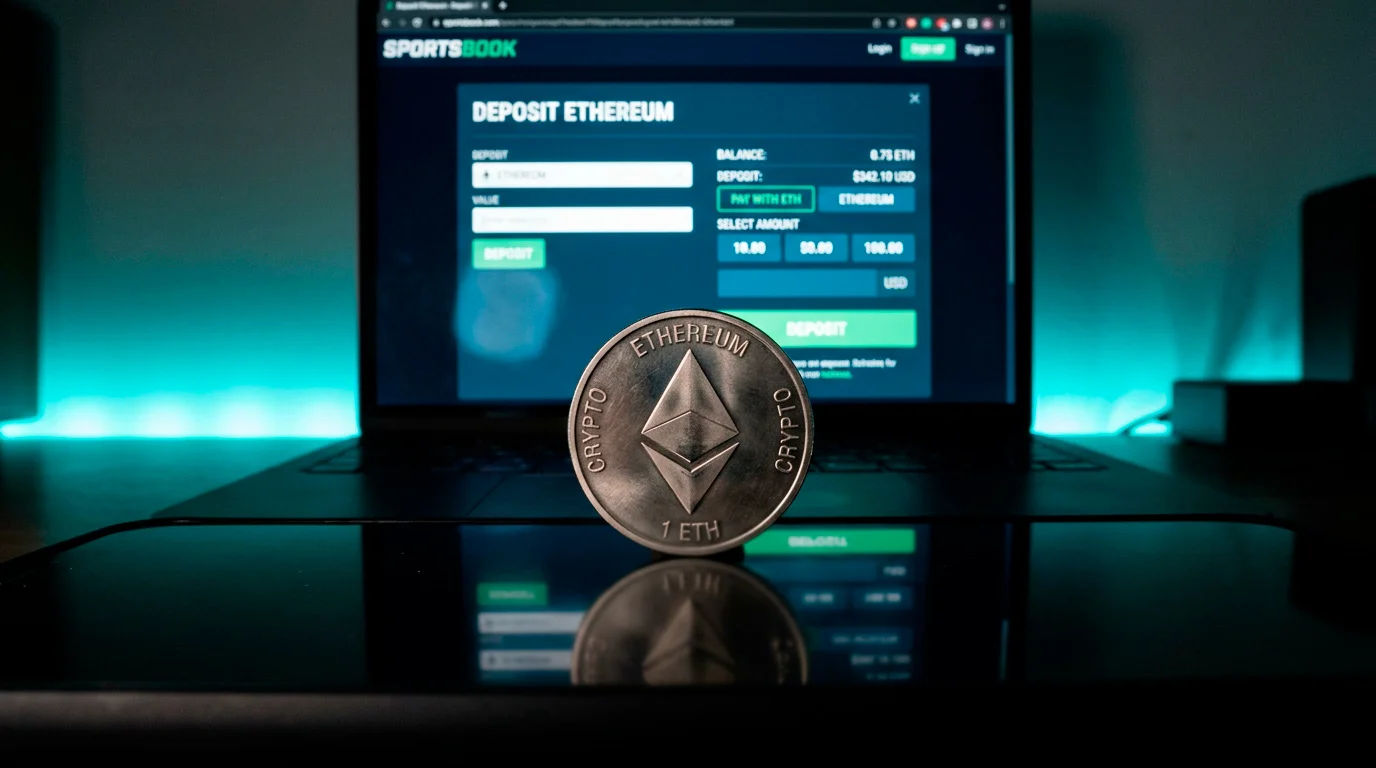
The deposit mechanics are straightforward: your sportsbook provides an Ethereum wallet address, you send ETH from your personal wallet, and the balance credits after a set number of confirmations — typically 12 to 30, which translates to roughly 3 to 7 minutes on the current proof-of-stake network. Ethereum’s transition from proof-of-work to proof-of-stake in September 2022 reduced energy consumption dramatically but did not meaningfully accelerate transaction speeds. Block times remain around 12 seconds, giving ETH a speed advantage over Bitcoin but a significant disadvantage against Tron-based USDT or Lightning Network payments.
Gas fees remain Ethereum’s Achilles heel for betting deposits. Unlike Bitcoin’s fee-per-byte model, Ethereum fees depend on network computational demand. A simple ETH transfer costs roughly 21,000 gas units, but the gas price fluctuates with network activity. During calm periods, a deposit might cost $1-3. During a popular NFT mint or DeFi protocol launch, the same transaction could spike to $15-30. I track gas prices before initiating deposits using on-chain gas estimation tools, and I time my sportsbook deposits for low-activity windows — typically Sunday mornings UK time, before the US wakes up.
Withdrawals follow the same fee dynamic. The sportsbook pays the network fee on some platforms (absorbing the cost as an operational expense), while others deduct it from your withdrawal amount. Knowing which model your sportsbook uses before you deposit avoids the surprise of a $12 fee deducted from a $200 withdrawal. That 6% overhead turns a winning betting session into a marginal one purely through transaction cost mismanagement.
The volatility profile of ETH mirrors the broader crypto market, making it a less stable denomination for sportsbook balances than stablecoins. During the 2025 NFL season, ETH fluctuated between roughly $1,800 and $3,200 — a range that could meaningfully affect your bankroll’s purchasing power across a 23-week season. Some bettors use ETH as a deliberate dual exposure strategy: long on Ethereum’s price and long on their NFL analysis. That works until both positions move against you simultaneously.
Ethereum’s Role in Smart Contract Sportsbooks
Where ETH distinguishes itself from every other betting currency is the smart contract layer. Ethereum’s programmable blockchain enables sportsbooks to build settlement systems where bet terms, odds, and payouts are coded into immutable contracts. When an NFL game concludes, an oracle feeds the result to the contract, and settlement executes automatically. No human grading, no manual review, no discretionary voiding.
This is not theoretical technology — it is live and handling real NFL wagers. The global crypto gambling market, projected to reach $65 billion by 2026, includes a growing segment of fully on-chain sports betting built on Ethereum and Layer 2 networks like Arbitrum, Optimism, and Base. These Layer 2 chains inherit Ethereum’s security guarantees while offering dramatically lower fees — often under $0.10 per transaction — making them practical for the smaller, more frequent wagers that sports betting demands.
For UK bettors, the smart contract dimension adds a transparency layer that offshore sportsbooks otherwise lack. At a traditional crypto bookmaker operating from Curacao, you trust the operator to honour your winning bets. At an Ethereum-based smart contract sportsbook, the payout logic is visible on the blockchain before you place the wager. That difference matters when you are operating outside the UKGC’s regulatory umbrella and cannot rely on institutional consumer protections.
The trade-off is usability. Interacting with a smart contract requires a Web3 wallet like MetaMask, an understanding of gas fees and transaction approval, and comfort with an interface that feels closer to a DeFi protocol than a betting app. The 15 million NFL fans in the UK include very few who are ready to navigate that experience today. But the infrastructure is maturing rapidly, and the abstracting wallets and one-click interfaces emerging in 2026 are closing the gap between traditional and decentralised betting experiences.
Layer 2 Networks and Cheaper ETH Betting
Layer 2 scaling has transformed the economics of Ethereum-based betting. Two years ago, placing a $50 NFL spread bet through an Ethereum smart contract cost $10-20 in gas fees — an absurd overhead that made on-chain sports betting economically irrational for any stake below several hundred dollars. Today, the same bet on Arbitrum or Optimism costs $0.05 to $0.20.
The mechanics: Layer 2 chains batch multiple transactions into a single Ethereum mainnet transaction, spreading the gas cost across hundreds or thousands of individual operations. Your NFL bet executes on the Layer 2 chain with fast finality and low fees, while the security of your funds is ultimately guaranteed by Ethereum’s base layer. Think of it as a fast checkout lane that leads to the same secure vault.
Bridging is the friction point. To use a Layer 2 sportsbook, you first move your ETH from the Ethereum mainnet to the Layer 2 chain via a bridge — a smart contract that locks your mainnet ETH and mints an equivalent amount on the L2 chain. This bridge transaction happens on mainnet and incurs mainnet gas fees, so the cost advantage only appears once you are “inside” the Layer 2 ecosystem. For a bettor making multiple deposits and wagers per week across NFL season, one bridge transaction followed by weeks of cheap L2 activity makes economic sense. For a one-off bet, the bridge overhead may not justify itself.
Adoption among sportsbooks is accelerating. Several crypto betting platforms now operate natively on Layer 2 chains, and the number is growing each quarter. The user experience gap between a Layer 2 sportsbook and a centralised platform has narrowed to the point where a bettor comfortable with MetaMask can navigate the interface without difficulty. For those not yet comfortable with wallet-based interaction, centralised crypto sportsbooks that accept ETH deposits via standard Ethereum transfers remain the simpler path — at higher fee cost.
Practical ETH Deposit Workflow for NFL Season
The workflow I have refined over several NFL seasons runs as follows. I purchase ETH on a UK-registered exchange early in the week, transfer it to my personal wallet (a hardware wallet for larger amounts, a software wallet for smaller operational balances), and deposit to my sportsbook on Wednesday or Thursday before Sunday’s games. That timing lets me clear exchange holds, complete wallet transfers, and have a confirmed sportsbook balance well before I need to place wagers.
For live betting, I maintain a small ETH balance at the sportsbook throughout the season. Waiting for an on-chain deposit to confirm while a live line moves against you is a mistake you make once. A pre-funded balance eliminates that friction entirely, though it introduces counterparty risk — your funds sit in the sportsbook’s custody until you withdraw them.
Gas optimisation is a season-long discipline. I batch my deposits when gas is low rather than making impulsive transactions during peak hours. Over a 23-week NFL season with weekly deposits, saving $5-10 per transaction in gas fees adds up to $115-230 — roughly the value of two solid NFL wagers. Small efficiencies compound when the time horizon extends across months of regular activity.
Is Ethereum faster than Bitcoin for sportsbook deposits?
Yes. Ethereum transactions confirm in roughly 3 to 7 minutes compared to 10 to 40 minutes for on-chain Bitcoin. Layer 2 Ethereum networks like Arbitrum settle in seconds. However, Lightning Network Bitcoin transactions are faster than standard Ethereum, settling in one to five seconds. The speed comparison depends on which specific technology you use.
Are Ethereum gas fees too expensive for small NFL bets?
On Ethereum mainnet, gas fees can make deposits under $100 impractical during high-congestion periods. Layer 2 networks solve this problem with fees under $0.20 per transaction. If you use Ethereum mainnet, timing deposits during low-activity periods and batching transfers minimises the fee impact across an NFL season.
Learn more about crypto nfl betting on our main page.
You may also find GamStop and Crypto Betting Sites: Why Self-Exclusion Does Not Apply Offshore interesting.
Written by the editors at Crypto nfl Betting.