Altcoin NFL Betting: Beyond Bitcoin and Ethereum at Crypto Sportsbooks
 Available in US
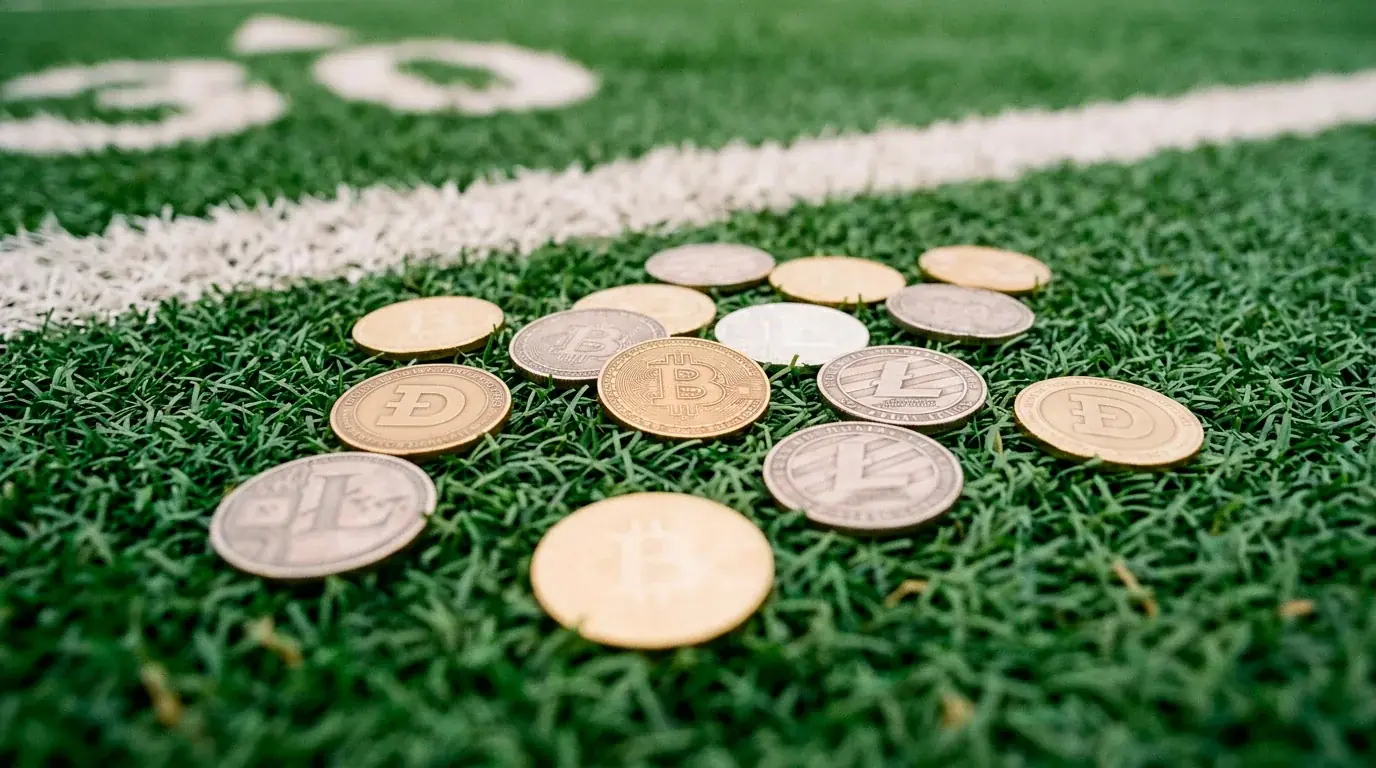
My first altcoin sports bet was a Litecoin wager on a Monday Night Football spread in 2021. I chose Litecoin for one reason: the sportsbook’s Bitcoin withdrawal queue was backed up, and LTC offered a faster path to getting my winnings out. That pragmatic decision opened a line of inquiry I have pursued ever since — which alternative cryptocurrencies actually make sense for NFL betting, which are gimmicks, and what the trade-offs look like in practice.
Bitcoin still dominates crypto gambling with roughly 66% of total volume, Ethereum accounts for about 9%, and Litecoin sits at 6%. The remaining share is fragmented across dozens of altcoins, each with different transaction speeds, fee structures, and levels of sportsbook support. For an NFL bettor in the UK, the question is not which coin is the most technically interesting — it is which one makes your betting workflow smoother, cheaper, and more reliable.
Litecoin: The Practical Alternative to Bitcoin
I keep coming back to Litecoin for sportsbook transactions, and the reason is boringly practical: it works. LTC confirms blocks every 2.5 minutes versus Bitcoin’s ten, fees are a fraction of BTC’s on-chain costs, and the network has been running since 2011 without a major security incident. It is not flashy. It does not generate the headlines that newer chains attract. But for the specific use case of moving funds between a wallet and a sportsbook, LTC delivers where it matters.
The 6% share of crypto gambling volume that Litecoin holds understates its utility for sports betting specifically. Casino players churning through slot spins care less about deposit speed — they are not racing a kick-off clock. NFL bettors who need funds available before a Sunday afternoon window find LTC’s faster confirmation genuinely useful when Bitcoin is congested. I have deposited LTC on a Saturday evening and had funds confirmed in under four minutes, while a simultaneous BTC test deposit at the same sportsbook took thirty-eight minutes during a busy fee market.
Sportsbook support for Litecoin is widespread. Most platforms that accept Bitcoin also accept LTC, and the withdrawal path is equally smooth. The main limitation is exchange availability — not all UK-accessible crypto exchanges offer direct GBP-to-LTC trading pairs, which means an extra conversion step when buying or selling. For bettors who already hold LTC or can acquire it easily, the transaction experience is superior to on-chain Bitcoin for the amounts typical of recreational NFL wagering.
Solana, Tron, and Newer Chains in the Sportsbook Ecosystem
The past two years have seen crypto sportsbooks expand well beyond the Bitcoin-Ethereum-Litecoin trio. Solana, in particular, has gained meaningful traction. SOL transactions settle in under a second with fees measured in fractions of a cent, and the growing DeFi ecosystem on Solana has pushed several sportsbook integrations. I tested Solana deposits at three platforms during the 2025 NFL season and found the experience comparable to TRC-20 USDT in terms of speed — nearly instant — with the added benefit of lower exchange fees when buying SOL with GBP at major UK-accessible exchanges.
Tron’s relevance in the betting space is less about TRX as a wagering currency and more about TRC-20 USDT. Stablecoins are projected to account for over 70% of crypto betting transactions by 2026, and TRC-20 is the dominant rail for those stablecoin transfers. Betting with TRX directly is possible at some platforms, but the coin’s price volatility and narrower exchange support make it less practical than simply using TRC-20 USDT for the transaction and keeping your bankroll dollar-pegged.
Dogecoin appears at a surprising number of crypto sportsbooks, more as a marketing feature than a serious betting currency. DOGE transaction fees are low and confirmations are reasonably fast, but the coin’s price volatility is extreme and its cultural association with meme trading does not inspire confidence in bettors managing a serious bankroll. I have used Dogecoin exactly once for a sportsbook deposit — to test whether the platform actually processed it — and would not build a betting strategy around it.
Ripple (XRP) occupies an interesting niche. Transactions settle in three to five seconds, fees are negligible, and the network handles high throughput. The challenge is regulatory uncertainty — XRP’s ongoing legal situation with the SEC has kept some sportsbooks cautious about adding support. Platforms that do accept XRP report low adoption rates among bettors, which suggests the market has not yet embraced it despite the strong technical credentials for payment use.
Evaluating Altcoins for NFL Betting: What Matters
After testing every altcoin deposit option I could find across crypto sportsbooks, I have distilled the evaluation down to four factors that matter in practice and one that does not.
Transaction speed matters, particularly for NFL betting where the difference between depositing before and after a kick-off window changes your entire session. Anything that confirms in under five minutes is functional for pre-game deposits; anything under thirty seconds enables mid-game top-ups if you use the right approach to live NFL betting. Bitcoin’s ten-minute blocks are fine for Monday deposits but frustrating on Sunday mornings.
Fee structure matters across a full season. The NFL betting market generates $9.5 billion annually, and the bettors contributing to that figure are making dozens of deposits and withdrawals over a 23-week season. A $5 fee per transaction adds up to $230 across 46 transactions (one deposit and one withdrawal per week). A $0.01 fee on TRC-20 or Solana adds up to less than fifty pence. The cost difference is not theoretical — it directly reduces your effective bankroll.
Exchange liquidity matters for UK bettors converting GBP. If you cannot buy or sell the altcoin efficiently at a major exchange with a GBP trading pair, you are adding conversion steps and spread costs. BTC, ETH, LTC, and SOL all have strong GBP liquidity at UK-accessible exchanges. More exotic altcoins may require buying BTC first and then converting, which introduces additional fees and time.
Sportsbook support breadth matters because your altcoin is useless if the platform you want to bet at does not accept it. Bitcoin is accepted at virtually every crypto sportsbook. ETH and LTC at most. USDT on TRC-20 at the majority. Beyond that, support is inconsistent, and checking before you acquire the coin is essential.
The factor that does not matter for practical betting purposes: the altcoin’s investment thesis. Whether Solana will outperform Ethereum over the next five years is interesting for your investment portfolio and irrelevant for your sportsbook transactions. You are using the coin as a payment rail, not a savings vehicle. The best altcoin for NFL betting is the one that moves your money fastest, cheapest, and with the widest platform support — not the one with the most compelling whitepaper.
Which altcoins can I use for NFL betting at crypto sportsbooks?
Beyond Bitcoin and Ethereum, the most widely supported altcoins at crypto sportsbooks are Litecoin, USDT on TRC-20, Solana, Tron, Dogecoin, and XRP. Support varies significantly between platforms. Litecoin and TRC-20 USDT have the broadest acceptance. Always verify which coins your specific sportsbook supports before acquiring cryptocurrency for deposits.
Is Litecoin faster than Bitcoin for sportsbook deposits?
Yes. Litecoin confirms blocks every 2.5 minutes compared to Bitcoin’s 10-minute average, and fees are significantly lower. For typical NFL betting deposit amounts, LTC provides a noticeably faster and cheaper transaction experience. Solana and TRC-20 USDT are faster still, settling in seconds rather than minutes.
Find the best options for crypto nfl betting.
Read our detailed review of Anonymous NFL Betting with Crypto: No-KYC Platforms and UK Realities.
Prepared by the Crypto nfl Betting editorial staff.